
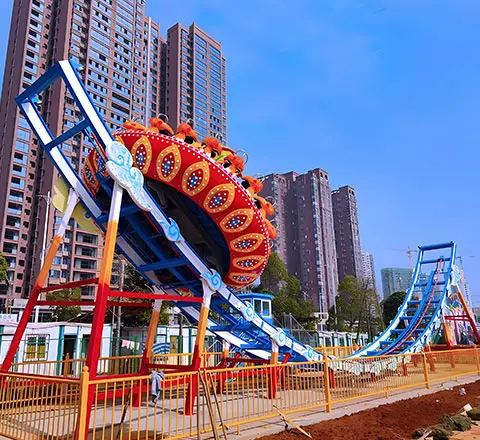


By Carnee Rides Amusement Park Engineering Team | Updated: October 2026
Installing a 36-seat flying chair ride requires careful planning before the equipment arrives. From confirming the site footprint and foundation design to arranging electrical connections, crane access, and commissioning, every stage affects your project budget, construction schedule, and opening date.
This guide is written for amusement park owners, investors, and project developers who are about to start civil works. It covers the essential 36-seat flying chair ride installation requirements: equipment dimensions, site preparation, foundation engineering, electrical planning, lifting operations, installation procedure, and pre-opening inspection — based on how we at Carnee Rides support these projects in practice.

1. 36-Seat Flying Chair Ride Specifications
Before starting civil construction, confirm the equipment configuration and dimensions. These specifications determine how much space to reserve, what information your foundation engineer needs, and how the ride should be integrated into your park layout.
Carnee Rides’ 36-seat Flying Chair Ride specifications are listed below.
| Technical Parameter | Specification |
| Passenger capacity | 36 riders |
| Rotational speed | 10–14 rpm |
| Rated power | 23.5 kW |
| Power supply | 380 V, 50 Hz |
| Equipment height | 6.8 m |
| Listed equipment size | D10 m × H8.5 m |
| Site-area diameter | 17 m |
| Approximate circular site area | 227 m² |
| Main structure material | Q235B steel, with 304 stainless steel seat frames |
| Typical design service life | 15 years |
The final configuration, operating envelope, electrical requirements, and installation dimensions should be confirmed in the approved technical drawings and equipment agreement before construction begins.
Which configuration are you buying? A standard swinging chair ride rotates and lifts its suspended seats beneath a canopy. Carnee Rides also manufactures a tilting variant that adds a hydraulic lifting and tilting mechanism, so the canopy tips to one side while rotating. The tilting version has a different height, drive arrangement, and foundation requirement. Confirm which configuration your project requires before starting civil works. If you are unsure, send us your site area and we will confirm the correct model and drawings.
What do the dimensions mean for your project?
The listed equipment size is D10 m × H8.5 m, while the specified site-area diameter is 17 m.
A circular area with a diameter of 17 m has a theoretical area of approximately 227 m². This provides a useful starting point for site planning, but it should not be treated as the total land area required for the entire attraction.
Your layout may also need space for:
- Safety fencing and controlled entry gates.
- Passenger queues and boarding areas.
- Unloading and exit routes.
- Emergency access and maintenance operations.
- Electrical equipment and the operator’s station.
- Delivery vehicles, component storage, and crane operations.
Before finalizing the layout, ask the manufacturer for the approved general arrangement drawing. It should identify the equipment footprint, relevant clearances, connection points, and installation interfaces for the selected configuration.
Important: The final overall height and overhead clearance must be confirmed from the approved drawing. Do not determine clearance from a single dimension on a product listing.
2. How Much Space Is Needed for a 36-Seat Flying Chair Ride?
For the Carnee Rides 36-seat Wave Swinger, the listed site-area diameter is 17 m, equivalent to approximately 227 m² of circular area.
However, the required project footprint depends on more than the equipment itself.
If you are installing the ride in an existing amusement park, evaluate the surrounding attractions, buildings, trees, pedestrian routes, underground utilities, and emergency access. For a new park, incorporate the ride into the overall master plan before the foundation and pedestrian circulation layouts are finalized.
Site planning checklist
Equipment footprint: Confirm the dimensions and installation envelope shown on the approved drawing.
Operating clearance: Account for the movement of the suspended seats and every part of the rotating structure. The equipment footprint alone does not define the complete operating envelope.
Passenger circulation: Provide practical entry, boarding, unloading, and exit arrangements. Queue capacity should reflect the expected visitor volume and operating plan.
Safety barriers: Position fencing and gates according to the manufacturer’s requirements and applicable local regulations.
Maintenance access: Make sure technicians can reach the areas that require inspection, servicing, and component replacement.
Construction access: Check whether delivery vehicles, lifting equipment, and installation personnel can reach the site without interfering with other attractions.
For projects with limited available space, a site layout review before construction can help identify potential conflicts early and reduce expensive modifications later.
3. Flying Chair Ride Foundation Requirements
The foundation is one of the most important parts of a flying chair ride installation. It transfers the loads generated by the equipment into the ground and provides the mounting interface for the main structure.
Foundation dimensions, reinforcement, anchor bolts, and concrete specifications must be determined for the actual ride configuration and site conditions. They should not be selected solely according to the passenger capacity or the outside dimensions of the equipment.

What should be confirmed before foundation construction?
1. Soil conditions and bearing capacity
Obtain the necessary geotechnical information and have the responsible engineer evaluate the site. Ground conditions can vary considerably between locations, even within the same amusement park.
2. Approved foundation drawings
Obtain the manufacturer’s foundation plan and the engineering information required for the selected model. Confirm the foundation dimensions, reinforcement arrangement, anchor-bolt positions, and installation tolerances.
3. Concrete and reinforcement
Verify the specified concrete grade, reinforcement details, and curing requirements with the approved structural design.
4. Anchor bolts and embedded components
Check the anchor-bolt layout and embedded components before pouring concrete. Electrical conduits and grounding provisions must also be coordinated with the approved installation drawings.
5. Foundation inspection and handover
Before equipment installation, complete the required dimensional checks and strength verification. Record the foundation condition and confirm that the installation team can proceed.
Reference foundation data for this configuration
For preliminary civil planning, the foundation design for a 36-seat wave swinger ride configuration of this size is typically based on the following values. These figures are indicative only and must be verified by your structural engineer against the approved foundation drawing and local site conditions.
| Foundation Item | Reference Value |
| Minimum ground bearing capacity | ≥ 10 t/m² |
| Concrete grade | C30 |
| Anchor bolts | 12 × M36, evenly spaced, grade 4.6, double-nut locking |
| Maximum vertical load at base | 200.1 kN |
| Maximum horizontal shear force | 26.6 kN |
| Maximum overturning moment | 183.8 kN·m |
| Typical base diameter | approx. Φ16.35 m |
Two details are frequently missed on site and cause rework:
- Embedded conduits and grounding must be fully in place before concrete is poured. Pouring is not permitted until these are complete.
- Grounding terminals and power conduit outlets must protrude at least 400 mm above the finished surface, and each foundation top must include a levelling layer.
Why should you confirm foundation loads before construction?
The foundation must be designed for the actual equipment loads and site conditions. These may include vertical forces, horizontal forces, overturning moments, and other loads specified by the manufacturer.
Ask Carnee Rides Amusement Rides Manufacturer for the applicable foundation drawings and technical data for your selected configuration. Your project engineer should then verify the foundation design against the site’s soil conditions and local building requirements.
Do not reuse a foundation design from another ride simply because the equipment has a similar passenger capacity. Different structural arrangements produce different loads and anchor-bolt requirements.
From our project experience: on several export projects, foundations had to be partially re-cast because embedded conduits or grounding terminals were poured in the wrong position. The correction typically adds 2–3 weeks and unplanned cost to the schedule. Confirming the embedded-component layout against the approved drawing before pouring is the single most effective way to avoid this.

4. Electrical Requirements for a 36-Seat Flying Chair Ride
Electrical planning should be completed before the equipment arrives. The power supply, control cabinet, grounding, protective devices, and cable routes all need to be coordinated with the installation team.
Carnee Rides’ 36-seat swing amusement park ride specifications list a rated power of 23.5 kW and a power supply of 380 V, 50 Hz.
These figures provide a starting point for electrical planning. They do not, by themselves, determine the required incoming supply capacity or the size of the circuit protection.
Before preparing the electrical installation, confirm the following:
- Rated voltage and frequency for the destination market.
- Total connected load and starting-current requirements.
- Cable specifications and cable-routing arrangements.
- Distribution equipment and electrical isolation.
- Grounding and protective devices.
- Control cabinet location and access.
- Emergency-stop functions and safety-control connections.
- Lighting and other auxiliary electrical loads, where applicable.
The final electrical design should follow the manufacturer’s wiring diagrams and the electrical regulations applicable at the project location.
Does 23.5 kW mean that a 23.5 kW power supply is sufficient?
Not necessarily. The equipment’s rated power and the required incoming electrical supply are not interchangeable planning figures.
The electrical engineer must consider the actual connected loads, motor starting characteristics, power factor where relevant, protective devices, and local supply conditions before selecting the incoming supply and cable sizes.
Confirm the final electrical requirements with Carnee Rides before purchasing electrical equipment or completing the site wiring.
5. Crane Access, Transportation, and Unloading
Large amusement rides require careful coordination between transportation, unloading, temporary storage, and installation.
Before delivery, confirm the shipping configuration and the dimensions and weights of the individual components. These details determine whether the transport vehicles can reach the site and what lifting equipment is required.
What should you prepare before delivery?
Access roads and gates
Measure the available road width, gate clearance, turning areas, overhead restrictions, and unloading position. Compare these measurements with the actual delivery vehicles and packaged components.
Crane positioning
Confirm the crane’s working position, lifting radius, ground conditions, and outrigger support requirements. The crane must have sufficient rated capacity at the actual working radius for the planned lift. For a ride of this size, a 16–25 t mobile crane is typically used, together with a 5 t forklift for on-site handling — but the final selection must follow the actual component weights and working radius, not a headline capacity figure.
Component storage
Prepare a stable, secure area for delivered components. Follow the manufacturer’s handling and storage requirements for the main structure, seats, chains, electrical equipment, and decorative parts.
Lifting arrangements
Identify the heaviest component, approved lifting points, rigging requirements, and lifting sequence. The lifting plan should be prepared and reviewed by the responsible professionals.
Delivery inspection
Check the packing list and inspect the delivered components for damage or missing parts before assembly begins.
Do not select a crane based solely on its headline lifting capacity. Its capacity at the required working radius, together with the component weight and lifting arrangement, determines whether it is suitable for the job.
If your project is located inside an existing park or shopping complex, plan delivery and lifting operations to minimize interference with visitors, staff, and nearby attractions.

6. Site Conditions Required During Installation
Installation should only proceed when the site conditions fall within the manufacturer’s specified limits. These limits protect both the installation crew and the structural integrity of the work.
| Condition | Requirement |
| Ambient temperature | 0–35 °C |
| Relative humidity | ≤ 85% |
| Wind speed during lifting and assembly | ≤ 10 m/s |
| Rescue and transport corridor | ≥ 4 m clear width, kept unobstructed |
| Temporary power supply | ≥ 50 kVA, plus lighting supply to the work area |
| Adverse weather | Installation must stop in rain, snow, or other severe conditions |
Before the installation team mobilizes, confirm the following are already in place:
- The foundation has passed acceptance by the design, construction, supervision, and owner’s representatives.
- A sufficiently large and level area is available for parking the crane and laying out components.
- The access route, unloading area, and component storage area are clear and ready.
Tools typically required on site: welding machine, electric torque wrench, electric drill, angle grinder, hammer, and hand tools.
7. Step-by-Step Flying Chair Ride Installation Process
A flying chair ride installation should follow the manufacturer’s approved procedures and be carried out by qualified personnel. In many countries, the operator of a large amusement ride must hold a license issued by the local special-equipment supervision authority; the installation itself should likewise be assigned to trained, authorized personnel. The exact sequence depends on the equipment configuration and site conditions.
For a broader overview of site preparation, foundation coordination, lifting, assembly, and acceptance testing, see our guide to How to Install Large Amusement Rides.

Step 1: Complete site preparation and handover
Before installation begins, confirm that the foundation has passed the required inspections and that the installation area is ready.
Check the access route, unloading area, lifting arrangements, electrical readiness, and component storage area. Confirm the work schedule and responsibilities with the installation team.
Step 2: Inspect the delivered equipment
Compare the delivered components against the packing list and approved drawings. Inspect the visible condition of structural parts, fasteners, seats, chains, electrical components, and other supplied items.
Report missing, damaged, or inconsistent components to the manufacturer before proceeding.
Step 3: Assemble the main structure
Qualified installation personnel should assemble the base frame, support structure, transmission components, rotating assemblies, and canopy in the sequence specified by the manufacturer.
Use the approved installation drawings to verify alignment, connections, fastener specifications, and tightening requirements.
Step 4: Install the seats and suspension chains
The seats and suspension chains are critical safety components. Their specifications, connection points, retaining devices, and installation arrangements must match the approved equipment configuration.
Inspect the seat attachment points, pins, locking devices, secondary safety components, and required clearances.
Do not rely on generic online instructions to dismantle seats, remove chains, or change chain lengths. These procedures are model-specific and should be performed only by trained, authorized personnel following the manufacturer’s instructions.
Step 5: Install the electrical and control systems
Install the control cabinet, wiring, sensors, protective devices, and other electrical components according to the approved drawings.
Verify the required connections, grounding, control functions, and safety circuits before powered testing.
Step 6: Install fencing and access controls
Complete the required safety barriers, entry and exit gates, warning signs, and access-control arrangements.
Check that passenger circulation is clear and that visitors cannot enter restricted operating or maintenance areas.
Step 7: Complete pre-commissioning inspections
Before testing, inspect the structural connections, rotating components, seats, suspension chains, restraints, electrical connections, control systems, and safety devices.
The responsible personnel should confirm that all required installation checks have been completed before proceeding to commissioning.
8. Suspension Chains, Seats, and Safety Inspections
The suspension chains and seat connections transfer passenger loads to the ride structure. Their condition is therefore essential to safe operation.
The inspection and maintenance plan should identify the applicable requirements for:
- Suspension chains and their connection points.
- Seat attachment pins and retaining devices.
- Secondary safety components.
- Seat frames, welds, and suspension lugs.
- Passenger restraints, buckles, and seat connections.
- Wear, corrosion, deformation, and other visible damage.
As a general reference, suspension chains and restraint anchor chains should be replaced when wear or elongation exceeds 10% of the chain diameter; attachment pins and clevis pins should be checked for loosening, wear, and corrosion; secondary safety wire ropes should be inspected for broken strands and loosened clamps; and seat frames and suspension lugs should be checked for deformation and weld cracking. The exact inspection frequency and replacement limits must follow the manufacturer’s maintenance manual and applicable regulations — do not assume that all swing rides use the same chain specifications, wear limits, lubrication procedures, or replacement intervals.
What should you do if a chain or seat attachment is damaged?
If a safety-critical component is damaged, loose, deformed, or outside its specified inspection limits, the ride must be taken out of service until qualified personnel have assessed and corrected the problem.
After a safety-critical component has been replaced or adjusted, complete the required inspections and tests before returning the ride to passenger operation.
Operators should also maintain inspection records and ensure that maintenance personnel know which components require routine checks and which conditions require immediate action.

9. Testing, Commissioning, and Pre-Opening Acceptance
Mechanical and electrical installation is not the final step. Before the ride opens to visitors, it must complete the required inspections, commissioning procedures, and applicable approvals.
Commissioning and acceptance should follow the manufacturer’s instructions and the applicable national or regional standard — for example EN 13814 in Europe, ASTM F24 standards such as F2291 in the United States, or the local special-equipment regulations in the destination country. Confirm with the manufacturer which standard applies to your project and which inspections are legally required before opening.
Pre-operation inspection checklist
Depending on the equipment configuration, inspections should cover:
- Main structural connections and foundation interfaces.
- Rotating and lifting mechanisms.
- Seats, suspension chains, and attachment points.
- Passenger restraints and safety barriers.
- Electrical systems and grounding.
- Control functions and safety interlocks.
- Emergency-stop functions.
- Abnormal noise, vibration, or mechanical interference.
Controlled test runs
Qualified personnel should conduct commissioning tests according to the approved procedure.
If abnormal movement, unexpected noise, excessive vibration, or a safety-system fault occurs, stop the test and investigate the cause before proceeding.
Do not begin passenger operation until the required commissioning checks and applicable approvals have been completed.
What documents should be prepared before opening?
Depending on local requirements and the project scope, the handover package may include:
- Approved technical and installation drawings.
- Operating and maintenance manuals.
- Installation and inspection records.
- Commissioning and functional-test results.
- Applicable certificates and inspection documents.
- Operator training records.
- Maintenance schedules and inspection logs.
Factory testing, on-site commissioning, and legally required local inspections are separate activities. Confirm which parties are responsible for each stage before the project begins.
10. How Long Does It Take to Install a 36-Seat Flying Chair Ride?
The total project schedule depends on equipment production, shipping, foundation readiness, site access, installation scope, commissioning, and local inspection requirements.
For a 36-seat ride of this size, the following ranges provide a practical starting point for your project plan:
| Project Stage | Typical Duration |
| Manufacturing | approx. 25–35 days |
| On-site installation | approx. 7 days |
| Local inspection and approval | approx. 7–20 working days |
| Foundation construction and curing | depends on site conditions and engineer’s design |
These ranges are indicative only. Production time depends on factory scheduling and customization; the installation period assumes the foundation has already been accepted and site access is ready; the local inspection timeline varies considerably by country and project scope.
Where possible, complete foundation construction, electrical preparation, access planning, and crane coordination while the equipment is being manufactured. This parallel planning can reduce delays caused by a site that is not ready when the equipment arrives.
Before committing to a park opening date, confirm the production lead time, shipping schedule, installation scope, commissioning arrangements, and local inspection process with the relevant parties.

11. Common Installation Mistakes to Avoid
Several preventable mistakes can increase installation costs or delay an amusement park project.
Confusing the equipment dimensions with the total site area
Carnee Rides lists a 17 m site-area diameter for its 36-seat Wave Swinger. The actual project layout may need additional space for fencing, queues, access routes, maintenance, and lifting operations.
Pouring the foundation before confirming the drawings
Foundation dimensions, anchor-bolt locations, and structural requirements must be confirmed before permanent concrete work begins. Embedded conduits and grounding must also be in place first — pouring in the wrong position is one of the most common causes of rework.
Assuming the rated power determines the entire electrical installation
The listed 23.5 kW rated power and 380 V, 50 Hz supply specification are starting points. The actual incoming supply, cable sizes, and protective devices require electrical engineering confirmation.
Selecting lifting equipment without checking the working radius
The crane must be suitable for the actual component weights and lifting conditions, not just the nominal load rating.
Using generic chain-installation procedures
Seat attachments and suspension chains are safety-critical. Installation, adjustment, and replacement must follow the correct model-specific instructions.
Leaving commissioning until the last minute
Testing, inspection, documentation, and operator training should be included in the project schedule from the beginning.
Opening before the required checks are complete
The ride must not enter passenger service until the required inspections, commissioning procedures, and applicable approvals have been satisfied.
12. 36-Seat Flying Chair Ride Pre-Installation Checklist
Use this checklist to coordinate the project before delivery.
| Item | What to Confirm |
| Passenger capacity | 36 riders |
| Listed equipment size | D10 m × H8.5 m |
| Equipment height | 6.8 m |
| Site-area diameter | 17 m |
| Approximate circular site area | 227 m² |
| Rotational speed | 10–14 rpm |
| Rated power | 23.5 kW |
| Power supply | 380 V, 50 Hz |
| Typical equipment weight | approx. 9–13 t (see FAQ below) |
| Foundation | Approved drawings, C30 concrete, ground bearing capacity ≥ 10 t/m² |
| Overhead clearance | Confirmed using the approved general arrangement drawing |
| Access and unloading | Vehicle access, turning space, and component storage |
| Lifting plan | Component weights, crane capacity, lifting points, and ground conditions |
| Electrical preparation | Supply, grounding, protection, and cable routing |
| Site conditions | Temperature 0–35 °C, humidity ≤ 85%, wind ≤ 10 m/s, ≥ 4 m corridor |
| Component inspection | Packing list and condition checks completed |
| Installation schedule | Responsibilities and milestones agreed |
| Commissioning | Testing and inspection plan confirmed |
| Handover | Manuals, maintenance records, training, and required approvals prepared |
The final installation requirements should be confirmed against the technical agreement and approved drawings for the equipment being supplied.
Frequently Asked Questions (FAQ)

Plan Your 36-Seat Flying Chair Ride Project with Carnee Rides
A successful flying chair ride installation begins with accurate specifications and a well-prepared site.
Confirming the equipment dimensions, foundation requirements, electrical supply, transportation access, lifting arrangements, and commissioning plan before construction can help reduce rework and keep your project on schedule.
Since 1998, Carnee Rides has specialized in amusement ride manufacturing, with more than 70,000 m² of workshop space, over 100 technical patents, and CE, TUV, ISO, and SGS certifications. We have delivered equipment to more than 2,000 projects across 120+ countries, and we provide OEM/ODM customization, site planning, equipment production, installation coordination, and after-sales support.
Whether you are adding a 36-seat Wave Swinger to an existing amusement park or developing a new entertainment venue, our team can help you evaluate the equipment configuration and the technical information required before installation.
Planning a 36-seat flying chair ride?
Explore Carnee Rides’ 36 Seats Wave Swinger Amusement Ride and click to inquire for factory-direct pricing. Share your project location, available site area, and installation requirements so our team can help you plan the next steps.


