
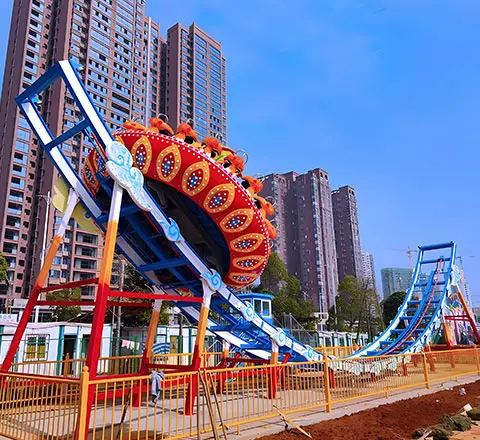


When planning park expansions or upgrading an FEC (Family Entertainment Center), operators inevitably ask one critical question: Is a pirate ship ride still worth the investment in 2026? With the rise of VR attractions and extreme coasters, you might wonder if this classic amusement park attraction still pulls its weight. The short answer is an absolute yes. A mid-size 24-seat pirate ship ride typically pays back its initial cost within 14 to 22 months at a modestly trafficked park—making it one of the highest-ROI amusement rides on the market.
If you plan to add a swinging ship to your venue, the decision hinges on ride capacity, manufacturer quality, and your daily footfall. This guide breaks down the true business case, exact ROI math, supplier comparisons, and the operational pitfalls most first-time buyers miss.

1. Why Pirate Ship Rides Are a Smart Amusement Park Investment
Pirate ship rides deliver one of the highest revenue-per-square-meter returns in the amusement industry. But beyond the math, here is what most first-time buyers miss: you’re not just buying a thrill ride—you’re buying a demographic bridge.
Roller coasters scare off families with young kids. Simple carousels bore teenagers. The pirate ship boat ride galleon threads both needles. Sitting in the “moderate thrill” sweet spot (2.5–3.5G peak force), it appeals to riders aged 6 to 60 and consistently generates 40%+ repeat-ride rates.
Key profitability drivers worth memorizing:
- High throughput: A well-run 24-seater Viking ship ride clears 350-480 riders/hour, preventing bottlenecks on busy weekends.
- Low footprint: A 15m × 8m operating area uses about one-fifth the land of a mid-size coaster.
- Minimal staffing: 1–2 operators per cycle keep labor costs below 8% of gross ride revenue.
- Predictable maintenance: The swinging pirate ship ride benefits from a mature engineering baseline. ASTM F2291 safety standards are well-established, translating to predictable operating expenses.

2. Investment Overview & Total Cost of Ownership
To ensure profitability, you must look beyond the manufacturer’s quoted sticker price. The Total Cost of Ownership (TCO) for a commercial Viking ship ride includes ocean freight, concrete foundations, 380V electrical hookups, thematic lighting, and first-year insurance.
While a medium 24-seat pirate ship amusement ride unit typically ranges from $25,000 to $55,000 ex-factory, skipping the “full-stack” math is the single biggest reason first-time operators blow past their budgets.
🔗 Important Note on Pricing: For an exhaustive, itemized breakdown of shipping fees, foundation costs, and exact price ranges by seating capacity (12, 24, and 40+ seats), please read our dedicated guide: How Much Does a Pirate Ship Ride Cost?

3. How to Calculate ROI: How Long Until It Pays Back?
Most operators hit payback between 14 and 22 months. The formula is straightforward: Daily Revenue = Throughput × Utilization × Ticket Price × Operating Hours. Here is the 5-step projection successful investors use, modeled on a regional park that recently deployed a $95,000 (fully landed and installed) 24-seat unit:
- Theoretical throughput: 24 seats ÷ 5-minute cycle (loading + ride + unloading) = 288 guests/hour.
- Apply realistic load factor: Multiply by 0.6 for weekdays, 0.85 for peak weekends (Let’s average 62%).
- Seasonal weighting: Assume 180 operating days in temperate climates.
- Revenue Calculation: At a $5 ticket, the ride generates roughly $90,000 – $110,000 in gross revenue.
- Subtract Opex & Calculate Payback: Deduct power (~8 kWh), two operators, insurance, and a 3-5% maintenance reserve. The park cleared roughly $71,000 net in year one—achieving a 16-month payback.
Pro tip: Always model a pessimistic scenario with a 40% load factor and 140 operating days. If payback still lands under 36 months, the investment is highly defensible.

4. Comparing Suppliers: Where to Buy Your Pirate Ship Ride
When searching for a pirate ship ride manufacturer, you generally face three tiers of suppliers. Matching your budget with the right tier while avoiding safety risks is critical.
- The Premium Route (European & American Suppliers): Brands from Italy or Germany offer an undeniable pedigree. However, you will pay a 2-3x brand premium (upwards of $400,000 for a 24-seater), wait 6-12 months for delivery, and face exorbitant costs for imported replacement parts.
- The Hidden Risk (Low-Tier Asian Suppliers): If a quote comes in unbelievably low (e.g., $18,000 for a 24-seat ship), walk away. These pirate ships often feature dangerously thin 4mm fiberglass (FRP), unmarked structural steel, photoshopped CE certificates, and zero after-sales support.
- The “Sweet Spot” (Top-Tier Chinese Manufacturers): The smartest money in 2026 flows here. Serious buyers want European-level engineering at factory-direct pricing. Reputable suppliers like Carnee Rides exemplify this tier. With over 20 years of export experience, Carnee Rides utilizes heavy-duty Q345B steel and strictly adheres to TÜV-audited CE and ASTM F2291 compliance. You get full customization and overseas installation support at 45-60% below European prices, drastically accelerating your ROI timeline.

5. Installation, Operation, and Long-Term Maintenance
Roughly 60% of lifetime profit depends on what happens after the crane leaves. A properly installed and serviced pirate ship ride delivers a 15-20 year service life.
- Site Prep: Pirate ships exert massive dynamic loads (up to 18 tons at peak swing for a 24-seater). You need a reinforced concrete foundation—typically 600mm thick with a rebar grid. Never rush the 28-day concrete curing process.
- Daily Inspections: Follow ASTM F770 operator standards. Daily 15-minute checks should cover hydraulic fluid levels, safety bar latching force, and abnormal bearing noise.
- Annual Pirate Ship Ride Maintenance: Budget for rebuilding hydraulic cylinders and inspecting gondola welds with dye penetrant. Train at least two operators per shift to ensure smooth, safe cycles.
6. Case Studies of Profitable Pirate Ship Ride Investments
The gap between a swing ship ride that pays back in 16 months and one that bleeds cash comes down to strategy.
- Case 1: Midwest FEC (The Bundling Strategy): A family entertainment center invested $78,000 all-in. Instead of selling à la carte tickets, they bundled the pirate ship into a $24 multi-ride wristband. This lifted per-capita spend by 31%, resulting in a lightning-fast 17-month payback.
- Case 2: The Underperformer (Location Error): A Texas operator bought a 40-passenger pirate ship fair ride but installed it behind a food court with poor sightlines. Ride capture dropped to 6%. Eighteen months later, they relocated the unit to a highly visible central plaza at a cost of $14,000, and revenue tripled immediately. Placement is not a detail; it’s the investment.

7. Frequently Asked Questions
- Can I finance a pirate ship ride? Yes. Equipment finance companies routinely underwrite amusement rides on 5-7 year terms. For first-time US buyers, SBA 7(a) loans work well.
- What import duties apply when buying from China? Under HTS code 9508.22, rides enter the US at a base 0% duty, but Section 301 tariffs currently add 25%. Always verify current rates before signing.
- Is a pirate ship a better investment than a 360 pendulum ride? For family parks, yes. Extreme pendulum rides cost 2-3x more and exclude riders under 52 inches, shrinking your addressable audience by roughly 35%. Pirate ships capture a much broader demographic. (Read our in-depth comparison on Pendulum Ride vs. Pirate Ship ROI to decide which fits your park best.)

8. Key Takeaways and Next Steps for Investors
Ready to add a highly profitable swinging ship amusement ride to your park? The decision comes down to realistic daily throughput, ticket pricing benchmarked to local competitors, and a payback target under 24 months.
Skip the trial and error of navigating unverified suppliers. Partner with a manufacturer that engineers lasting attractions, not just cheap steel.
Contact the engineering team at Carnee Rides today. Share your site dimensions with us, and we will provide a free theme park design, an itemized ROI projection, and a competitive factory-direct quote to kickstart your next successful project.


