
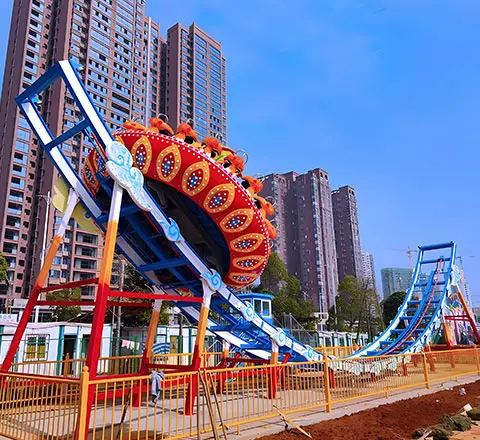


A Star Flyer ride is a high-altitude tower swing attraction that lifts suspended seats along a central tower while rotating riders above the park. It combines open-air flight, height, wind and panoramic views in one ride experience.
You may also see this equipment sold as a Sky Flyer ride, tower swing ride, swing tower ride, flying tower ride, Star Tower Swing or high-altitude swing ride. These names describe the same general category, but they do not guarantee identical specifications.
Two suppliers can both quote a “44m Star Flyer” while offering different passenger operating heights, seat arrangements, footprints, safety systems and installation scopes. One quotation may include lighting, export packing and installation supervision; another may cover only the basic equipment.
That is where buyers get caught. The product names look comparable, but the projects behind them are not.
This guide explains what amusement park owners, scenic-area developers and international buyers should check before choosing a model, approving a quotation or starting foundation construction.
Buyers reviewing commercial configurations can also visit the Carnee Rides Sky Flyer ride for sale page.
Star Flyer Ride Specifications at a Glance
The following table shows reference specifications for three Carnee Rides models. Final capacity, electrical configuration, dimensions and project conditions should be confirmed in the signed technical agreement.
| Model | Equipment Height | Operating Height | Rated Power | Equipment Occupancy Area | Approx. Weight | Recommended Project Positioning |
| CN-SF-32 | 32m | 18m | 67kW | Ø22m | 22 tons | Medium amusement parks and regional attractions |
| CN-SF-44 | 44m | 29m | 67kW | Ø24m | 40 tons | Established parks and city entertainment projects |
| CN-SF-56 | 56m | 37m | 82kW | Ø30m | 68 tons | Large parks, resorts and landmark tourism projects |
The occupancy diameter is not the total land required for the project. It normally excludes queue lines, safety fencing, entrance and exit gates, the operator booth, electrical equipment, maintenance access, emergency routes and crane working space.
What this means for your project: approve the complete operating and installation layout—not only the equipment diameter—before civil construction begins.

What Is a Star Flyer Ride?
A Star Flyer ride is a classic thrill amusement ride built around a tall vertical tower. Riders sit in suspended swing chairs attached to a rotating top structure, then rise and spin high above the ground to experience height, speed, open-air flying sensations, and strong excitement. Because of its iconic appearance and thrilling ride experience, the Star Flyer has become one of the most popular large swing tower rides in amusement parks, carnivals, and scenic destinations.
Passengers board at ground level. After the restraints have been checked, the passenger assembly begins to rotate and move upward along the tower. As the rotational speed increases, the suspended seats swing outward.
The experience comes from three coordinated movements:
- Vertical ascent
- Circular rotation
- Outward movement of the swing seats
Unlike an observation tower, passengers are seated in open chairs rather than an enclosed cabin. Unlike a drop tower, the main thrill does not come from a sudden vertical fall. Riders experience height, wind, continuous rotation and an open view of the surrounding park.
For an operator, the attraction can perform two jobs at once: it sells ride tickets and creates a visible landmark that draws attention from other areas of the park.

How Does a Star Flyer Ride Work?
A normal operating sequence includes:
- Passengers enter the loading area and take their seats.
- Operators close and inspect each restraint.
- The passenger assembly begins rotating at low speed.
- The assembly rises along the tower.
- Rotation gradually increases and the seats move outward.
- The ride operates at its programmed height and speed.
- Rotation slows before the platform descends.
- The equipment returns to the loading position.
- Restraints are released and passengers exit.
The lifting and rotating systems must remain coordinated throughout the cycle. Position sensors, speed controls, brakes and safety interlocks monitor the equipment and prevent normal operation when required conditions have not been met.
Here is what a simple specification sheet may not tell you: maximum design speed is not necessarily the same as normal operating speed. Smooth acceleration and deceleration are just as important as the highest speed figure.

What Are the Main Components?
A commercial Star Flyer amusement ride combines structural, mechanical, electrical and passenger-protection systems.
The main assemblies normally include:
- Central steel tower
- Rotating passenger crown or platform
- Vertical lifting and guiding system
- Drive motors and reducers
- Service and emergency brakes
- Swing seats
- Suspension chains, cables or connecting assemblies
- Passenger restraints
- Electrical control cabinet
- PLC and speed-control components
- Position and limit sensors
- Operator control station
- Decorative panels
- LED lighting
- Foundation connections and anchor components
A product photo can show colors and appearance, but it tells the buyer little about the quality of these systems.
Before approving a supplier, ask how structural materials are verified, how critical welds are inspected, which electrical components are used and which replacement parts will be supplied.
What Does the Ride Feel Like?
The experience is a combination of height, wind and continuous circular movement rather than a sudden free fall.
At the beginning of the cycle, passengers feel the rotating platform rise. As it gains speed, the seats move farther away from the tower and create a stronger flying sensation.
Ride intensity depends on:
- Passenger operating height
- Rotational speed
- Acceleration program
- Swing angle
- Ride duration
- Seat design
- Wind conditions
Open seating can make the ride feel more intense than an enclosed attraction, even when the motion is relatively smooth.
Star Flyer Ride vs. Other Swing and Tower Rides
How Is a Star Flyer Different from a Traditional Flying Chair Ride?
A traditional flying chair ride normally rotates close to ground level. A Star Flyer adds a vertical tower and lifting system, creating a much higher passenger position and stronger skyline effect.
| Feature | Star Flyer Ride | Traditional Flying Chair |
| Main movement | Vertical ascent and rotation | Primarily rotation |
| Typical positioning | Family thrill or thrill ride | Family or children’s attraction |
| Visual impact | Strong landmark value | Mainly visible inside the park |
| Foundation | Tower-specific foundation | Usually less complex |
| Wind exposure | Higher | Lower |
| Installation | Heavy lifting and tower erection | Generally simpler |
Treating a tower swing ride as merely a taller flying chair ride is a sourcing mistake. The tower changes the wind exposure, foundation load, installation method and maintenance plan.
A lower chair swing may suit a family park with limited height approval, while a tower attraction is designed for greater elevation and landmark value. See our detailed guide to the differences between a carnival swing ride and a swing tower ride.
How Is a Star Flyer Ride Different from a Drop Tower Ride ?
Both attractions use a tall vertical structure, but the passenger experiences are very different.
A drop tower raises a passenger carriage and creates its main thrill through rapid vertical descent. A Star Flyer rotates suspended seats around the tower, focusing on height, wind and outward swinging.
Choose a Star Flyer when the project needs:
- Panoramic views
- Open-air flight sensations
- Continuous visible movement
- Strong nighttime lighting potential
- A ride suitable for a broader family-thrill market
Choose a drop tower when the main objective is a rapid falling sensation and strong momentary acceleration.
Buyers comparing the two attractions can read the full Swing Tower Ride vs. Drop Tower Ride comparison.

Is a Tower Swing the Right Type of Swing Ride for My Park?
A tower swing amusement ride is only one category within the wider swing ride family.
Some parks may be better served by a lower rotating swing ride, wave swinger or Hurricane-style attraction, particularly when the target audience is younger or the site has limited height approval.
Before choosing a Star Flyer amusement ride height, confirm whether this movement style matches your visitor profile. Our comparison of Hurricane, rotating, tower and wave swinger rides explains how the main swing ride categories differ.
Height, Capacity and Model Selection

How High Is a Star Flyer Ride?
There is no single standard height for every Sky Flyer ride.
Carnee Rides’ current reference configurations have equipment heights of 32m, 44m and 56m. Their approximate passenger operating heights are 18m, 29m and 37m.
Equipment height and operating height are not the same measurement.
Equipment height describes the complete structure, including tower sections, mechanical areas and upper decoration. Operating height refers to the approximate level reached by the passenger assembly during normal operation.
Picture a buyer comparing two “44m” offers. One supplier is referring to total tower height. The other is describing the height reached by passengers. Both quotations may use the same headline number, but the ride experience and engineering scope will not be comparable.
What to put in your RFQ: require both total equipment height and passenger operating height.
Which Star Flyer Model Should I Choose?
The right model is the one that fits the site, visitor volume and complete investment plan. The tallest configuration is not automatically the best choice.

32m Star Flyer Ride
The 32m model can suit medium amusement parks, regional attractions and projects with a controlled civil-work budget.
Reference specifications include:
- 18m operating height
- 67kW rated power
- Ø22m equipment occupancy area
- Approximately 22 tons equipment weight
It can create a recognizable tower attraction without moving into the foundation and lifting requirements of the largest models.
44m Star Flyer Ride
The 44m version offers a stronger skyline presence and a higher passenger viewpoint while maintaining a reference occupancy diameter of approximately Ø24m.
Its equipment weight increases to around 40 tons. That difference affects more than freight. It also changes the foundation load, crane plan and erection procedure.
This configuration may suit established amusement parks, scenic attractions and city entertainment projects seeking a signature ride.
56m Star Flyer Ride
The 56m model is intended for larger amusement and tourism projects where long-distance visibility is part of the investment objective.
Reference specifications include:
- 37m operating height
- 82kW rated power
- Ø30m equipment occupancy area
- Approximately 68 tons equipment weight
Here is where a height decision becomes an engineering decision. The larger structure brings greater wind exposure, heavier components and more demanding lifting conditions.
Choose it because the site, visitor forecast and business plan support it—not simply because the taller rendering looks more impressive.
How Many Passengers Can a Star Flyer Ride Carry?
Commercial models commonly use single or double suspended seats. Many configurations carry approximately 32 to 36 passengers per cycle, although final capacity depends on the selected seat layout and approved design.
The quotation should state:
- Number of seat units
- Passengers per seat
- Rated capacity per cycle
- Maximum approved load per seat
- Any seat-balancing requirements
- Minimum rider requirements
A higher seat count does not automatically produce higher real-world capacity. Loading time, restraint checks and average occupancy also affect performance.
Are Single or Double Seats Better?
Double seats are generally more suitable for family-oriented amusement parks. They allow friends, couples or an eligible child and adult to ride together.
They can also make the experience feel less intimidating for first-time riders.

Single seats may support a more individual thrill-ride concept, but the decision should be based on the target audience and operating plan rather than appearance alone.
Compare:
- Visitor age profile
- Loading efficiency
- Passenger comfort
- Restraint arrangement
- Seat capacity
- Theme positioning
How Many Riders Can It Handle Per Hour?
Hourly throughput should be calculated from actual dispatch time, not ride movement time alone.
Use the following formula:
Actual hourly capacity = passengers per cycle × completed cycles per hour × average seat occupancy
A four-minute ride program does not necessarily produce fifteen fully loaded cycles every hour. Operators also need time to admit passengers, check eligibility, arrange seats, inspect restraints and unload the previous group.
Weather interruptions, empty seats and additional safety checks reduce theoretical capacity further.
Here is where financial forecasts often become unrealistic: the buyer calculates revenue from maximum seat count and ride duration, then operates at a lower dispatch rate.
What this means for your business plan: use a conservative passenger-throughput figure when estimating revenue.

How Fast Does a Star Flyer Ride Go?
The answer depends on what is being measured.
A technical specification may describe:
- Rotational speed
- Passenger linear speed
- Vertical lifting speed
- Maximum design speed
- Normal programmed speed
These figures should not be treated as interchangeable.
For the passenger experience, smooth acceleration and deceleration matter as much as peak speed. A professionally programmed cycle should build movement gradually and return passengers to the loading position without abrupt changes.
Ask the manufacturer to explain the complete operating program rather than providing only a maximum speed figure.
How Long Does One Star Flyer Ride Cycle Last?
The programmed ride time is adjustable and usually lasts about 2 to 5 minutes. Including boarding, restraint checks and unloading, a complete dispatch cycle generally takes around 6 to 10 minutes.
Operators may choose from approved ride programs, but speed and duration should remain within the settings confirmed by the manufacturer.
For capacity planning, use the complete dispatch cycle rather than the ride time alone.
How Much Power Does a Star Flyer Need?
Reference rated power for the three Carnee models is:
- 32m model: 67kW
- 44m model: 67kW
- 56m model: 82kW
The complete electrical plan may also need to support:
- Control cabinets
- LED lighting
- Operator-room equipment
- Grounding
- Surge and lightning protection
- Emergency systems
- Auxiliary equipment
Buyers should provide the local voltage and frequency before production. Electrical components or transformers may need to be adjusted for the destination market.
Site Area, Foundation and Civil Engineering
How Much Space Does a Star Flyer Ride Need?
Reference equipment occupancy diameters are:
- CN-SF-32: Ø22m
- CN-SF-44: Ø24m
- CN-SF-56: Ø30m
These figures do not represent the entire site requirement.
The project layout must also include:
- Safety fencing
- Queue lines
- Entrance and exit gates
- Operator booth
- Electrical equipment
- Maintenance access
- Emergency routes
- Guest viewing areas
- Drainage
- Installation crane access
- Component unloading and storage space
Here is what snares buyers: the ride fits on the initial drawing, but the operation does not.
Picture a park reserving a 24m circle for a 44m model. Landscaping and surrounding paths are completed before the installation plan is reviewed. The ride itself fits, but the crane cannot reach the required position and the emergency route crosses the proposed queue.
The equipment has not changed, but the site must now be redesigned.
What this means for your build: approve the operating layout and installation plan before fixing the foundation position.
What Site Information Should I Send to the Manufacturer?
An accurate proposal requires more than a preferred height and budget.
Provide:
- Project country and city
- Available site dimensions
- CAD drawing or master plan
- Current site photographs
- Soil or geotechnical information
- Local wind and climate conditions
- Altitude
- Voltage and frequency
- Nearby structures
- Overhead cables
- Expected visitor traffic
- Preferred capacity
- Target opening date
- Required installation support
Incomplete RFQs create incomplete quotations. The missing cost does not disappear; it usually returns later as a contract variation, local purchase or construction delay.
What Foundation Does a Sky Flyer Amusement Ride Require?
The foundation must be designed for the specific model, local soil and environmental loads.
The design should consider:
- Equipment weight
- Passenger load
- Dynamic operating forces
- Wind load
- Tower overturning moment
- Soil bearing capacity
- Groundwater
- Concrete strength
- Reinforcement
- Anchor arrangement
- Applicable local codes
Equipment weight alone is not enough to size the foundation.
A 56m model weighs approximately 68 tons, but the foundation does not merely support 68 tons of stationary steel. It must also resist operational forces and the wind action created by a tall structure.
A common sequencing mistake is to confirm the model and begin production before completing the soil investigation. If the site has weak bearing conditions, the civil-work cost may change significantly.
What this means for your project: confirm the model, soil information and preliminary foundation solution together.
Who Designs the Foundation?
The amusement ride manufacturer normally supplies structural loads, anchor information and foundation-related technical conditions for the selected equipment.
Depending on the destination, a locally licensed structural or civil engineer may need to review, adapt or approve the design under local construction rules.
The contract should clarify:
- Which drawings the manufacturer provides
- Whether reinforcement information is included
- Who checks the soil conditions
- Who signs the final civil design
- Who supplies anchor components
- Who inspects the completed foundation
- Which construction tolerances apply
“Foundation drawing included” is not precise enough for an international project. Buyers should confirm whether the supplier provides only foundation loads and an anchor-bolt layout, or a complete civil foundation drawing covering concrete dimensions, reinforcement, embedded parts, construction tolerances and design assumptions. The contract should also clarify whether a locally licensed engineer must review or approve the foundation according to the site’s soil report and local building codes.
What this means for your project: define exactly which foundation documents the manufacturer supplies, who adapts them to local conditions, and who is responsible for final approval before construction begins.
Where Should the Ride Be Located?

A good location combines visibility with practical operation.
Suitable positions may include:
- A central park axis
- A main entrance sightline
- An open plaza
- A scenic viewpoint
- A waterfront destination
- A high-traffic park zone
- An area visible during evening operation
Before approving the position, check:
- Overhead power lines
- Nearby buildings
- Trees inside the operating clearance
- Height restrictions
- Drainage
- Emergency vehicle access
- Residential noise sensitivity
- Crane setup conditions
A well-positioned 44m Star Flyer Ride may create more commercial value than a poorly placed 56m tower hidden behind buildings.
Can a Star Flyer Ride Be Installed Indoors?
Large commercial Star Flyer rides are primarily designed for outdoor projects.
An indoor installation would require a building designed around the equipment, with sufficient:
- Structural height
- Horizontal swing clearance
- Foundation capacity
- Heavy-equipment access
- Emergency planning
- Ventilation
- Maintenance space
A high ceiling alone is not enough. The seats need horizontal clearance, and large components must be able to enter and be lifted inside the building.
Is a Star Flyer Ride Fixed or Portable?
Most large tower swing rides are permanent installations unless the specific model has been engineered for repeated transport and assembly.
A travelling Star Flyer carnival ride requires different provisions for:
- Frequent dismantling
- Road transport
- Temporary support systems
- Faster assembly
- Repeated connection inspections
- Fairground regulations
A fixed model does not become portable simply because it can be dismantled.
Rider Requirements and Star Flyer Ride Safety
Are Star Flyer Rides Safe?
Yes. A professionally designed, properly manufactured and correctly installed Star Flyer ride is a safe and reliable commercial amusement ride when it is inspected, maintained and operated according to the manufacturer’s requirements.

Safety does not depend on one component alone. It is supported by a complete protection system that includes:
- Engineered steel structures, verified materials and qualified welding
- Passenger restraints and electrical safety interlocks
- Drive, braking, sensing and emergency recovery systems
- Accurate foundation construction and correct installation
- Weather monitoring and clearly defined operating limits
- Trained operators, routine inspections and preventive maintenance
Buyers should not judge safety only by whether the ride has a seat belt or another visible restraint. A professional supplier should also explain how restraints are locked and monitored, how the ride stops during an abnormal condition, how passengers are returned safely during a power failure, and how wind limits and critical components are inspected.
For buyers, the key question is not whether one safety feature is included, but how the entire ride is protected throughout design, operation and maintenance.
What Passenger Restraints Are Used?
Depending on the final seat design, a commercial tower swing may use:
- Safety belts
- Lap bars
- Overhead restraints
- Mechanical locking devices
- Secondary restraints
- Electronic or position monitoring
- Operator visual confirmation
The exact configuration should be written into the technical agreement.
Ask the supplier:
- How does the restraint lock?
- How is its status checked?
- What prevents an incorrect start?
- How is it released during an emergency?
- Which components are wear parts?
- What passenger sizes can it accommodate?
“Double protection” is useful only when both protective methods are clearly identified.
Is There a Minimum Rider Height?
There is no universal minimum height for every Star Flyer ride.
The approved limit depends on:
- Seat dimensions
- Restraint geometry
- Intended passenger category
- Adult-accompaniment rules
- Equipment design
- Local regulations
- Final inspection approval
Do not copy a height restriction from another park’s website. Its ride may use different seats and restraints.
The correct requirement should appear in the operating manual, passenger signage and local acceptance documents.
Is There a Rider Weight Limit?
Yes. Seats, suspension components and restraints are designed for defined loads.
The manufacturer should state:
- Maximum individual passenger load
- Maximum combined load for a double seat
- Restraint-fit requirements
- Any seat-balancing instructions
- Conditions requiring refusal of boarding
A claim that the ride has no passenger weight limit should be treated cautiously.
In operation, every passenger must fit the seat and allow the restraint to close and lock in its approved position.
Can Children Ride?
Children may ride when they meet the approved height, restraint and accompaniment requirements.
A Star Flyer is normally positioned as a family-thrill or thrill attraction rather than a small kiddie ride. Even when a child meets the physical requirements, the open seating and height may feel intimidating.
Operators should not pressure an unwilling child to ride.
A lower flying chair or junior swing attraction may be more appropriate for parks mainly serving young children.
Who Should Not Ride?
The final passenger restrictions must follow the approved operating manual and local rules.
Depending on the equipment and site requirements, restrictions may apply to guests with:
- Certain heart conditions
- Serious back or neck problems
- Recent surgery
- Pregnancy
- Severe motion sensitivity
- Conditions preventing correct restraint use
Generic online warning lists should not replace model-specific operating instructions.
Can the Sky Flyer Ride Operate in Strong Wind?
The ride must stop when wind conditions reach the approved limit for the specific model and site.
High-altitude swing rides are more exposed to wind than many ground-level attractions. A proper operating plan should cover:
- Wind-speed monitoring
- Gust conditions
- Warning levels
- Shutdown limits
- Controlled passenger descent
- Restart requirements
- Weather records
There is no single shutdown wind speed that should be copied for every tower swing ride. The approved value must come from the final engineering documents, operating manual and destination requirements.
Can It Run in Rain or Lightning?
Light rain may be permitted under some operating conditions, but lightning, strong wind and poor visibility require clear shutdown procedures.
Operators must consider:
- Passenger exposure
- Slippery loading areas
- Electrical protection
- Wind gusts
- Visibility
- Braking and control conditions
- Local regulations
The most restrictive applicable rule should be followed.
What Happens During a Power Failure?
A commercial Star Flyer needs a documented controlled-stop and passenger-recovery procedure.
Depending on the system, it may involve:
- Automatic braking
- Auxiliary power
- Emergency lowering
- Manual recovery controls
- Passenger communication
- Site emergency support
This should be discussed before ordering, not after commissioning.
Ask the manufacturer to explain in writing how passengers will be returned to the loading position if normal power becomes unavailable.
What Inspections Are Required Before Opening?
The equipment should pass factory testing, site commissioning and any required local acceptance process.
The inspection scope may include:
- Material verification
- Structural dimension checks
- Welding inspection
- Non-destructive examination of critical areas
- Mechanical assembly inspection
- Electrical and control testing
- Brake testing
- Restraint inspection
- Empty-load operation
- Load testing
- Emergency-system testing
- Foundation and anchor inspection
- Site commissioning
- Third-party or regulatory acceptance
“Factory tested” does not mean “approved to operate at your site.” The foundation, installation and destination requirements must also be checked.
How Should Buyers Think About Accident-Related Searches?
Any large amusement park attraction requires controlled engineering, maintenance and operation.
When reviewing an incident, do not assume the ride type alone explains the cause. An official investigation may examine:
- Equipment condition
- Installation quality
- Maintenance history
- Passenger restraints
- Weather
- Operator actions
- Unauthorized modifications
- Compliance with procedures
For a buyer, the useful question is whether the proposed supplier can demonstrate a controlled process from design and manufacturing through installation, testing and after-sales support.
Safety Standards, Documents and Local Approval
Which Standards Apply to a Star Flyer Ride?
A Star Flyer ride is not governed by one universal, Star Flyer-specific standard. The applicable requirements depend on the destination country, official ride classification, local regulations and the standards specified in the purchase contract.
For projects using the ASTM system, the main reference standards commonly include:
- ASTM F2291 for amusement ride design and major modifications
- ASTM F1193 for manufacturing, construction and quality assurance
- ASTM F770 for ownership, operation, maintenance, inspection and staff training
For European projects, the EN 13814 series is commonly used:
- EN 13814-1: design and manufacture
- EN 13814-2: operation, maintenance and use
- EN 13814-3: inspection during design, manufacture, operation and use
For projects installed in China, large amusement rides are primarily subject to GB 8408-2018, Large-scale Amusement Device Safety Code, together with TSG 71-2023, Safety Technical Regulation for Large-scale Amusement Devices. Depending on the equipment classification and project scope, manufacturer licensing, design appraisal, type testing and statutory inspection may also be required.
Additional structural, electrical, welding, foundation and non-destructive-testing standards may apply to specific parts of the project. The technical agreement should identify these standards by number and edition instead of using only the vague phrase “international standards.”
Before ordering, buyers should confirm:
- The destination country and official ride classification
- The applicable standard numbers and editions
- The required engineering review, third-party inspection and test reports
- The documents the manufacturer will supply
- Responsibility for registration and final operating approval
A manufacturer’s certificate or third-party inspection report alone does not guarantee local approval. Therefore, the applicable standards, required documents and approval responsibilities should be confirmed before design and production begin.
What Documents Should the Manufacturer Provide?
Depending on the project and destination requirements, the document package may include:
- General arrangement drawing and technical specifications
- Foundation load information and anchor-bolt drawings
- Electrical diagrams
- Installation, operation and maintenance manuals
- Lubrication schedule and spare-parts list
- Material certificates and welding inspection records
- Factory test, commissioning and load-test records
- Emergency operating procedures
- Packing list
The required document language, format, approval status and delivery schedule should be agreed upon before the contract is signed.
Star Flyer Ride Price and Total Project Cost
How Much Does a Star Flyer Ride Cost?
For standard fixed models in the 32m to 56m category, buyers may use an approximate EXW planning range of:
US$160,000 to US$400,000 or more
This is a broad budgeting range, not a final quotation.
The actual Star Flyer ride price depends on:
- Equipment and operating height
- Structural weight
- Seat configuration
- Drive system
- Control components
- Passenger restraints
- LED lighting
- Theme decoration
- Destination voltage
- Corrosion protection
- Required documentation
- Spare parts
- Installation support
Customized configurations or projects with additional technical and documentation requirements may fall outside this range.
Why Do Supplier Prices Vary So Much?
Different prices often represent different scopes.
One supplier may include lighting, export packing, initial spare parts, manuals, factory testing and installation supervision. Another may quote only the basic equipment.
That is why comparing only the final number can be misleading.
Before approving a quotation, compare:
- Technical specifications
- Materials
- Main components
- Safety systems
- Documentation
- Packing
- Installation services
- Spare parts
- Exclusions
- Warranty scope
The lowest equipment price is not necessarily the lowest complete project cost.
What Is Usually Excluded from the EXW Price?
EXW normally covers the equipment at the manufacturer’s facility. It does not represent the total installed investment.
Additional costs may include:
- Inland transport to the export port
- Export handling
- International freight
- Cargo insurance
- Import duty
- Local taxes
- Customs clearance
- Delivery to the site
- Soil investigation
- Foundation construction
- Electrical infrastructure
- Crane rental
- Local installation labour
- Engineer travel
- Accommodation and visas
- Fencing and queue systems
- Local inspection
- Registration and permits
Picture a buyer approving an attractive factory price, then discovering that tower sections require special inland transport and that a suitable crane is difficult to rent near the site.
The EXW price has not changed. The project budget has.
What this means for your investment: calculate the landed and installed cost before signing the supply contract.
What Should a Professional Quotation Include?
A professional quotation should state:
- Product model
- Equipment height
- Passenger operating height
- Occupancy area
- Equipment weight
- Passenger capacity
- Seat arrangement
- Power and voltage
- Main structural material
- Restraint system
- Control system
- Lighting
- Decoration
- Spare parts
- Technical documents
- Packing
- Trade terms
- Production period
- Installation scope
- Warranty
- Excluded work
A quotation stating only “one Star Flyer ride” and a total price is not detailed enough for a major equipment purchase.
What Are the Main Operating Costs?
The main recurring costs include:
- Electricity
- Ride operators
- Loading attendants
- Technical maintenance
- Periodic inspections
- Lubricants and wear parts
- Electrical replacement parts
- Lighting maintenance
- Insurance
- Cleaning and security
- Weather-related downtime
Rated power does not equal continuous electricity consumption. Actual energy use depends on the operating program, number of daily cycles, lighting and opening hours.
How Long Does a Star Flyer Ride Take to Pay Back?
For a project with stable visitor traffic and appropriate ticket pricing, a practical planning target may be approximately 1.5 to 3 years. A seasonal or low-traffic location may need more than three years.
This is not a guaranteed return. The actual payback period depends on:
- Total landed and installed investment
- Ticket price
- Paying riders per day
- Annual operating days
- Labour and electricity
- Maintenance costs
- Weather and technical downtime
Consider a simplified example:
- Total installed investment: US$300,000
- Average ticket price: US$8
- Paying riders per day: 220
- Annual operating days: 250
Annual gross revenue = US$8 × 220 riders × 250 days = US$440,000
If approximately 35% to 45% of gross revenue remains available to recover the original investment after operating expenses, the annual operating contribution would be around US$154,000 to US$198,000.
Under those assumptions, the estimated payback period would be approximately 1.5 to 2 years.
Traffic changes the result quickly. If the same attraction receives only 100 paying passengers per day, recovery may take more than four years.
Use this formula for initial planning:
Estimated payback period = total installed investment ÷ annual net operating contribution
Prepare conservative, normal and peak-season scenarios. Do not calculate ROI from maximum seat capacity or the EXW price alone.
How Can Operators Improve Revenue?
A Star Flyer can create value beyond standard daytime tickets.

Possible strategies include:
- Evening operation
- LED lighting programs
- Sunset ride sessions
- Combination tickets
- Fast-pass products
- Festival themes
- Group packages
- Brand sponsorship
- On-ride photography
- Short-form video products
These services are easier to implement when they are considered during the layout and electrical-design stage.
Customization and Environmental Adaptation
Can a Star Flyer Ride Be Customized?
A commercial tower swing can be customized within engineering and approval limits.
Common options include:
- Equipment height
- Seat arrangement
- Tower colors
- Crown design
- Decorative panels
- Park logo
- Seat appearance
- LED lighting
- Control language
- Voltage and frequency
- Corrosion protection
- Theme elements

Functional specifications should be approved before visual details.
Changing a color during design is relatively simple. Changing the seat quantity, tower structure or electrical scope after production begins can affect price and delivery time.
What Changes Are Needed for Coastal or Harsh Environments?
Coastal salinity, humidity, high temperature, cold weather, sand and strong ultraviolet exposure can affect the coating and component specification.
Provide environmental information early so the manufacturer can evaluate:
- Anti-corrosion treatment
- Coating process
- Fastener materials
- Electrical-cabinet protection
- Cable selection
- Sealing
- Maintenance intervals
A standard inland coating should not automatically be assumed suitable for every coastal or desert project.
Shipping, Installation and Project Timeline
How Is a Star Flyer Ride Shipped?
The tower and major assemblies are divided into transportable sections.
A shipment may include:
- Tower sections
- Rotating crown
- Mechanical assemblies
- Passenger seats
- Suspension components
- Control cabinets
- Lighting equipment
- Decorative parts
- Anchor components
- Spare parts
Structural sections require secure fixing during transport. Electrical and mechanical components may need enclosed cases, moisture protection and corrosion prevention.
Container type and quantity depend on:
- Selected model
- Component dimensions
- Destination port
- Inland road restrictions
- Shipping route
Do not use one generic freight estimate for every height. Request a preliminary packing plan for the selected model.
What Must Be Ready Before the Equipment Arrives?
The buyer should prepare:
- Completed and properly cured foundation
- Verified anchor positions
- Site access
- Unloading area
- Component storage area
- Crane plan
- Local labour
- Temporary electrical supply
- Installation tools
- Safety barriers
- Engineer accommodation and transport where required
A frequent delay occurs when the equipment reaches the site before civil work is ready. Storage costs increase and the installation team cannot begin.
Coordinate production, shipping, foundation construction and crane availability as one schedule.
How Is a Star Flyer Ride Installed?
The general installation sequence includes:
- Foundation and anchor inspection
- Delivered-component inventory
- Tower-section assembly
- Tower erection
- Rotating crown and drive installation
- Seat and suspension installation
- Electrical connection
- Lighting and decoration
- Alignment and fastening checks
- Empty-load testing
- Load testing
- Operator and maintenance training
- Local acceptance
The exact sequence depends on the model and site conditions.
What Size Crane Is Required?
Crane selection depends on:
- Heaviest single component
- Lifting height
- Working radius
- Ground conditions
- Assembly sequence
- Site obstacles
Total equipment weight is not enough to choose a crane.
A 68-ton ride is not lifted as one 68-ton component. The installation engineer needs the weight and lifting points of each major assembly and must calculate the crane capacity at the actual working radius.
How Long Does the Complete Project Take?
The project timeline includes more than factory production.
Typical stages are:
- Site review
- Model selection
- Technical agreement
- Drawing approval
- Production
- Factory testing
- Export packing
- International shipping
- Foundation construction
- Installation
- Commissioning
- Training
- Local approval
Here is the scheduling mistake to avoid: asking only for production time and treating it as the opening date.
Customs, foundation work, crane availability and local inspection can all affect the final schedule.
Plan backward from the target opening date and assign responsibility for every stage.
Operation, Maintenance and Service Life
Who Can Operate a Star Flyer Ride?
Only trained and authorized personnel should operate the equipment.
The operating team may include:
- Main control operator
- Loading attendants
- Restraint-check staff
- Maintenance technician
- Site supervisor
Their responsibilities include checking passenger eligibility, inspecting restraints, monitoring weather, responding to alarms and recording daily checks.
Local regulations may require additional staffing or qualifications.
What Should Be Checked Every Day?
Daily inspection should focus on passenger-protection systems, suspended components, controls and visible abnormal conditions.

Typical items include:
- Seats and restraints
- Suspension components
- Pins and fasteners
- Gates and interlocks
- Emergency stop
- Sensors
- Brakes
- Control panel
- Foundation and anchor areas
- Abnormal noise
- Unusual vibration
- Empty-load trial operation
The final checklist should match the selected model and operating manual.
What Periodic Maintenance Is Required?

Preventive maintenance may include:
- Lubrication
- Bolt and connection checks
- Brake inspection
- Motor and reducer maintenance
- Electrical-cabinet cleaning
- Sensor testing
- Restraint inspection
- Suspension-system inspection
- Corrosion treatment
- Structural inspection
- Foundation checks
- Emergency-system testing
Tasks should be divided into daily, weekly, monthly, seasonal and annual schedules according to the manufacturer’s manual and local requirements.
What Spare Parts Should Be Kept on Site?
A practical spare-parts package can prevent avoidable downtime.
Depending on the final configuration, it may include:
- Limit switches
- Proximity sensors
- Relays
- Contactors
- Fuses
- Control buttons
- Restraint components
- Pins and fasteners
- Bearings
- Brake wear parts
- Seals
- LED modules
- Specified lubricants
A small sensor may be inexpensive, but waiting for international delivery during peak season is not.
Agree on the initial spare-parts package before shipment.
How Long Does a Star Flyer Ride Last?
Many fixed commercial Star Flyer rides have a stated design service life of around 10 years. With proper daily maintenance, scheduled inspection and timely replacement of critical components, some rides may remain in service for up to 15 years.
Components such as the main shaft, suspension arms, connecting pins, bearings and passenger restraints must be inspected and replaced according to the manufacturer’s maintenance requirements. Operating frequency, climate, corrosion exposure and maintenance quality will also affect the ride’s actual service life.
Once the stated design life has been reached, the ride should not continue operating automatically. A qualified inspection authority must evaluate the structure and key systems. Continued operation is permitted only after the ride passes the required safety assessment and receives approval under local regulations.
Therefore, buyers should ask the manufacturer to specify the design service life, inspection intervals, critical-component replacement requirements and end-of-life assessment procedure in the technical documents.
Choosing a Star Flyer Ride Manufacturer

How Do I Evaluate a Manufacturer?
Choose a Star Flyer ride manufacturer based on engineering and project-delivery capability rather than renderings or headline price.
Review:
- Real production facilities
- Experience with large tower rides
- Engineering team
- Material control
- Welding procedures
- Inspection capability
- Electrical-system experience
- Factory testing
- Similar completed projects
- Installation support
- Technical manuals
- Spare-parts availability
- After-sales response
A useful question is:
Can you provide a successfully completed Star Flyer project in our country or a nearby market, preferably with a similar height and capacity, and explain exactly what your company supplied?
A relevant local or regional case can help buyers evaluate the supplier’s experience with transportation, installation, local approval and after-sales support—not just equipment manufacturing.

What Supplier Red Flags Should Buyers Watch For?
Be cautious when:
- Equipment height and operating height are not distinguished.
- Passenger capacity is unclear.
- The footprint is given without explaining additional site space.
- Material grades cannot be supported by documentation.
- The supplier uses “international standard” without naming one.
- Emergency recovery is not explained.
- The quotation has no clear exclusion list.
- Installation responsibility is vague.
- No spare-parts list is available.
- Similar completed projects cannot be shown.
- The price is unusually low but the technical scope is unclear.
The least expensive quotation is not always the lowest-cost project.
What After-Sales Support Should Be Included?
The service agreement should explain:
- Warranty start date
- Covered components
- Wear-part exclusions
- Fault-reporting process
- Remote support
- Spare-parts supply
- On-site service conditions
- Operator responsibilities
- Maintenance requirements
- Response procedure
A long warranty has limited value when the supplier cannot diagnose a fault or supply the correct replacement component.
Can I Import a Star Flyer Ride from China?
Yes. For buyers seeking a balance between investment cost, customization and dependable manufacturing, importing a Star Flyer ride from China can be a practical choice.
Compared with many European suppliers, including established Italian manufacturers, Chinese amusement ride manufacturers often offer more competitive pricing because of lower production costs and a mature supply chain. Reputable Chinese suppliers can also provide reliable steel structures, control systems, safety devices, technical documents and international installation support.
However, lower pricing should not be the only reason to choose a supplier. Buyers should verify the manufacturer’s production qualifications, completed projects, material records, inspection procedures, applicable standards and after-sales capability.
International projects also require clear coordination between the manufacturer, freight provider, local civil contractor, installation team and inspection authority.
When the supplier has proven engineering experience and the technical scope is clearly defined, importing a high-altitude Star Flyer ride from China can provide strong value without sacrificing essential quality and safety requirements.
What Services Does Carnee Rides Provide?
As a Chinese one-stop amusement ride manufacturer with more than 20 years of industry experience, Carnee Rides provides support throughout the entire project—from initial planning and equipment production to installation, commissioning and after-sales service.
Our services may include:
- Pre-sales support: project consultation, model selection, site-layout planning, capacity recommendations, customization and quotation
- Production support: technical agreement confirmation, drawing preparation, production updates, quality inspection, factory testing and export packaging
- Shipping coordination: packing lists, loading plans, shipping documents and international transport assistance
- Installation support: installation manuals, online video guidance, remote technical assistance or the dispatch of technicians and installation workers to the project site
- Commissioning and training: equipment testing, operating guidance and maintenance training
- After-sales service: troubleshooting, maintenance advice, spare-parts supply and long-term technical support
The exact service scope depends on the destination country, project conditions and contract. Items such as cranes, local labor, accommodation, visas and inland transportation should be clearly assigned before installation begins.
From project planning to long-term operation, Carnee Rides aims to provide buyers with a complete and clearly coordinated amusement ride solution.
Final Star Flyer Ride Buyer Checklist
Before approving the order, confirm that:
- Equipment height and operating height are both stated.
- Passenger capacity and seat layout are defined.
- The complete operating area has been planned.
- Soil and wind conditions have been reviewed.
- Foundation responsibilities are clear.
- Rider requirements are documented.
- Electrical configuration matches the destination.
- Restraints and emergency recovery are explained.
- Required standards and documents are named.
- The quotation has clear inclusions and exclusions.
- Shipping and installation responsibilities are assigned.
- Factory and site testing are defined.
- Staff training is included.
- Initial spare parts are prepared.
- Revenue calculations use realistic passenger throughput.
- The total installed investment—not only EXW price—has been evaluated.
Request a Custom Star Flyer Ride Proposal
The right Star Flyer ride is not simply the tallest model or the lowest quotation. It is the configuration that fits your site, foundation conditions, target visitors, operating plan and total investment.
Carnee Rides supplies commercial tower swing attractions with customizable appearance, LED lighting, electrical systems and project support.
Send your project location, site dimensions, preferred height, local voltage and target opening date to receive a preliminary model recommendation, layout plan and factory quotation.


