
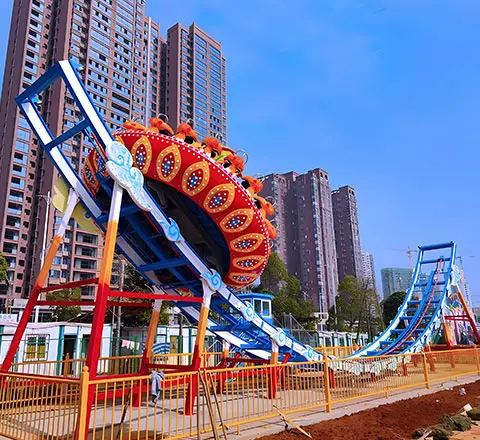


Yes, a Tagada ride can be installed on an upper floor in some projects, but only after the exact ride configuration and the building structure have been reviewed together.
For a shopping mall, indoor amusement park or Family Entertainment Center (FEC), the decision cannot be made from equipment weight or a quoted floor-load figure alone. A Disco Tagada rotates, carries a changing passenger load and produces repeated vertical movement, so engineers also need to consider dynamic loads, vibration, base support points, load distribution, structural beams and columns.
If you are considering an upper-floor Tagada ride installation, the safest starting point is to select a preliminary model, mark the proposed position on your building drawings, and send both to the manufacturer for technical review. The final structural solution should then be confirmed by a qualified engineer responsible for the building.
Quick answer: A floor rating such as 1,000 kg/m² may be useful as an initial reference for a specific project, but it should never be treated as universal approval for installing a Tagada.

Why Is an Upper-Floor Tagada Installation Different?
A Disco Tagada ride is very different from arcade machines, children’s coin-operated rides, and other static attractions commonly found in shopping malls.
During operation, the circular platform rotates while the motion system creates vertical or bouncing movements. Passengers also move and shift their weight as the ride accelerates and changes direction.
If you want to understand the motion before considering its structural effects, our guide to how a Disco Tagada ride works explains the relationship between the rotating platform, drive system, vertical movement and control system.
From a building perspective, four factors are particularly important.
1. Static Weight Is Only the Starting Point
The stationary load includes the:
- Main steel frame
- Rotating platform
- Seating and padding
- Drive and motion system
- Electrical components
- Decorative structure
- Base frame
- Passengers
Knowing the total equipment weight is necessary, but it does not tell the complete story.
One mistake buyers sometimes make is:
total ride weight ÷ equipment footprint = required floor capacity
That may be useful for a very early screening calculation, but it cannot confirm whether the building is structurally suitable.
The load is not necessarily distributed uniformly over the entire footprint, and the equipment does not remain static while operating.
A Tagada Ride Generates Dynamic Loads
Once the Spinning ride starts operating, the load condition changes.
The building may need to accommodate effects associated with:
- Platform rotation
- Vertical bouncing
- Acceleration and deceleration
- Repeated motion cycles
- Changing passenger distribution
- Vibration transmitted through the base
- Local reactions at structural support points
This is why Tagada ride floor load requirements cannot be judged only by comparing equipment weight with a floor’s nominal kg/m² capacity.
ASTM International’s F2291 Standard Practice for Design of Amusement Rides and Devices provides an established engineering framework for amusement ride design, including load and strength considerations and requirements relevant to different ride systems.
It does not replace the local building code, but it illustrates an important principle: amusement ride loads have to be considered as an engineered operating condition rather than simply as the weight of a stationary machine.
3. Base Design Determines How Loads Enter the Building
Two machines with similar total weights can create different structural conditions if their bases transfer loads through different areas and support points.
For an upper-floor amusement ride, the base may need to be designed so that loads are spread over a larger structural area instead of concentrating excessively at a few locations.
Depending on the project, a customized steel support frame may help:
- Increase the effective load-bearing area
- Coordinate support points with the building structure
- Distribute reactions over a wider zone
- Transfer loads more effectively toward suitable beams
However, a larger base does not solve every structural problem.
If the building itself does not have sufficient capacity, changing the ride base cannot magically make the floor safe.
4. The Exact Position on the Floor Matters
A floor does not have identical structural behavior everywhere.
The proposed Tagada position needs to be reviewed in relation to:
- Main beams
- Secondary beams
- Columns
- Slab spans
- Structural joints
- Existing openings or penetrations
A ride positioned near an appropriate load-transfer path can create a very different structural condition from the same ride placed in the middle of a long floor span.
That is why a manufacturer should not approve an installation from a venue photograph alone.
Is 1,000 kg/m² Enough for a Disco Tagada Ride?
This question came directly from a buyer who planned to place a Tagada on a non-ground level.
For that particular enquiry, the preliminary technical discussion included a floor load condition of approximately ≥1,000 kg/m², together with a recommendation to position the machine in relation to the building’s main structural beams where practical.
But this number needs to be understood correctly.
1,000 kg/m² is not a universal Tagada ride installation standard.
It was a project-specific preliminary condition.
Whether the same floor capacity is sufficient for another project depends on:
| Factor | Why It Matters |
| Exact Tagada model | Different models have different structures and operating characteristics |
| Total ride weight | Establishes the basic permanent load |
| Passenger capacity | Full-load operation must be considered |
| Dynamic movement | Rotation and bouncing change the load condition |
| Base support points | Determine how loads are transferred to the floor |
| Beam layout | Influences load-transfer paths |
| Column locations | Connect the ride load to the primary structure |
| Slab type and span | Affect floor structural behavior |
| Motion intensity | Stronger movement can change operating forces |
| Local structural code | Determines final building approval |
For projects using U.S.-based structural design practice, for example, ASCE/SEI 7 provides the general framework for design loads and load combinations for buildings and other structures.
Other countries use their own building and structural standards.
The applicable rules at the installation location always take priority.
A Better Question Than “Is 1,000 kg/m² Enough?”
Instead of asking:
My floor supports 1,000 kg/m². Can I install this Tagada?
A technically useful question is:
Here is the exact Tagada model, its load information, the proposed base layout and my building structural drawings. Can this position safely transfer the operating loads into the building structure?
That gives both the ride manufacturer and the structural engineer enough information to start making a real engineering decision.
Why the Exact Tagada Disco Ride Model Must Be Selected First
Buyers sometimes ask for the floor requirement before deciding which Tagada they actually want.
That order should usually be reversed.
Carnee Rides offers different capacities and configurations, and even Tagada rides with a similar platform diameter may not have identical specifications.
For example, in a recent Carnee quotation, several commercial Tagada configurations used a 5 m platform diameter, but their specifications were not identical:
- Passenger capacity ranged from 24 adults to approximately 30–40 passengers
- Rated power ranged from approximately 26 kW to 30 kW
- Some configurations listed an overall footprint around 9 × 9 m
- Another configuration was listed at approximately 8 × 10 × 4.5 m
So:
same platform diameter does not mean same machine.
Capacity, structural configuration, power, equipment height, motion system and supporting structure may differ.
This is why a structural engineer needs the technical information for the exact unit being purchased, rather than a generic specification copied from another Tagada model.
If you are still deciding between capacities and configurations, see our guide on how to choose a Tagada ride before starting the structural review.
What About the Equipment Weight?
The commercial quotation alone may not include every engineering value required for a structural check.
Before approving an upper-floor installation, the selected model should have a technical package that confirms the information required by the building engineer, which may include:
- Equipment weight
- Maximum operating/passenger load
- Base dimensions
- Support locations
- Load or reaction information required for structural design
- Equipment height
- Operating envelope
- Motion configuration
- Electrical requirements
- Anchorage or support concept
In other words:
Do not use a sales quotation as a structural calculation sheet.
The quotation helps you select the machine. The engineering information helps determine whether the building can accommodate it.
What Should You Send the Manufacturer Before Asking “Can It Go Upstairs?”
For most upper-floor Tagada ride projects, providing good site information early saves more time than repeatedly discussing a single floor-load number.
The manufacturer should ideally receive:
Building Structure Information
- Structural floor plan
- Main and secondary beam locations
- Column positions
- Floor slab information
- Available design floor-load data
- Existing structural reinforcement information, if applicable
Proposed Ride Location
Mark the exact intended position directly on the drawing.
This is important because phrases such as “first floor” can mean different levels in different countries.
Instead, clearly indicate:
- Building level
- Room or zone
- Ride center point
- Entrance direction
- Available operating area
Venue Dimensions
Provide:
- Available length and width
- Clear ceiling height
- Distance to walls and columns
- Nearby stairs and exits
- Sprinkler and HVAC positions
- Queue and passenger circulation areas
Site Access
Also show how the equipment will reach the final installation position.
Useful information includes:
- Loading entrance dimensions
- Door width and height
- Corridor dimensions
- Freight elevator size
- Elevator load limit
- Turning space
- Crane or forklift access
- Whether large components can be assembled inside
Site Photos and Video
Photos alone cannot replace drawings, but they help the technical team understand:
- Surrounding structures
- Ceiling obstacles
- Actual access conditions
- Existing finishes
- Available assembly space
A short walkthrough video from the unloading point to the installation area can be particularly useful for indoor amusement park projects.

Floor Load Is Not the Only Problem: Space, Vibration and Installation Access Matter Too
Some proposed Tagada installations fail before structural calculations become the main issue.
The reason is simple:
The venue may support the ride structurally but still be unsuitable operationally.
Check Ceiling Height and the Full Operating Envelope
Do not compare ceiling height only with the stationary equipment height.
Allow for:
- Maximum vertical movement
- Decorative backdrop
- Lighting
- Music equipment
- Sprinklers
- HVAC ducts
- Ceiling signs
- Maintenance clearance
A Tagada designed for an outdoor amusement park cannot automatically be moved indoors just because the turntable diameter fits the room.
Check the Whole Operating Area, Not Just the Disc Diameter
A 5 m turntable does not mean you need only a 5 m × 5 m room.
The complete layout may also require:
- Entry stairs
- Passenger loading area
- Safety fencing
- Operator station
- Queue space
- Maintenance access
- Electrical cabinet
- Emergency exit routes
This is also why our Tagada Ride Installation Guide recommends checking site access, operating clearance, foundations or floor conditions, electrical supply and passenger flow before assembly begins.
Ask This Before Shipping: Can the Components Reach the Site?
This problem is often underestimated in shopping malls.
Imagine confirming the floor structure and then discovering that:
- the freight elevator is too small,
- one component exceeds its load rating,
- the corridor cannot accommodate the turning radius,
- or a structural frame cannot pass through the entrance.
The machine may fit perfectly after assembly but still be impossible to move into the building.
Transport access should therefore be reviewed before production and shipment, not when the container arrives.
Consider Vibration and Noise
A Disco Tagada combines:
rotation + vertical movement + passenger movement + music + structural vibration.
On a dedicated ground foundation, vibration primarily affects the ride and its foundation.
In a multi-story building, it may also affect:
- Shops or entertainment venues below
- Adjacent tenants
- Interior finishes
- Sensitive building services
- Guest comfort
- Noise complaints
Depending on the building, an engineering solution may involve a modified support structure, connection design or vibration-isolation strategy.
These measures should be designed for the specific project.
A generic rubber pad added after installation should not be treated as a substitute for an engineering vibration review.
What If You Want a Faster or More Powerful Tagada Upstairs?
This is another question we received during an actual Tagada enquiry.
The buyer had watched a demonstration video and felt that the ride’s vertical movement looked relatively gentle. They wanted:
- Faster rotation
- Stronger vertical movement
- Quicker bouncing
- Greater movement range
- A more intense rider experience
From a commercial perspective, that is a reasonable customization request.
From an engineering perspective, however, increasing ride intensity is not only a software setting.
Stronger Movement May Change the Structural Condition
If the motion becomes more aggressive, the technical team may need to review:
- Motion system capacity
- Cylinder or actuator configuration
- Air supply or drive system
- Platform structure
- Control parameters
- Dynamic forces
- Base reactions
- Support structure
- Building suitability
This is especially important when the ride is installed above ground level.
A structural design approved for one operating configuration should not automatically be assumed suitable after a significant motion upgrade.

Pneumatic, Hydraulic or Mechanical?
Buyers often refer to any large cylinder under a Tagada as a “hydraulic cylinder.”
That is not always correct.
For the model discussed in this particular upper-floor enquiry, the vertical movement system was pneumatic rather than hydraulic.
Some other Tagada designs may use different movement technologies, and Carnee also offers configurations with mechanical bouncing systems.
This matters because the chosen motion system affects:
- Equipment configuration
- Utility requirements
- Maintenance
- Movement response
- Space around the base
- Technical data needed for installation
Before evaluating the building, confirm exactly which version you are buying.
A Practical Upper-Floor Tagada Amusement Ride Approval Process
The easiest way to avoid structural surprises is to follow the right order.
Step 1: Define What You Actually Need
Start with your operation rather than the building calculation.
Confirm:
- Target passenger capacity
- Available floor area
- Target audience
- Desired thrill level
- Indoor or outdoor operation
- Preferred theme
- Expected operating hours
You can compare available commercial Tagada rides for sale before selecting a preliminary configuration.
Step 2: Send the Site and Structural Drawings
Mark the exact location where the ride would be installed.
Include beam and column layouts whenever available.
Step 3: Obtain Model-Specific Technical Data
Do not evaluate the building using specifications from a different capacity or similar-looking model.
Confirm the actual configuration first.
Step 4: Manufacturer Technical Review
The ride manufacturer reviews the equipment side of the project:
- Model suitability
- Space requirement
- Base arrangement
- Operating envelope
- Motion system
- Installation access
- Required utilities
Step 5: Building Structural Engineer Review
The manufacturer understands the ride.
The structural engineer understands the building.
Neither should replace the other.
The building engineer should evaluate the ride information against:
- Floor slab
- Beams
- Columns
- Connections
- Existing structural capacity
- Dynamic effects
- Applicable local building requirements
Step 6: Decide Whether the Original Position Still Makes Sense
There are generally three possible outcomes.
Option A: Use the proposed position.
The structure is suitable and the support arrangement can be finalized.
Option B: Modify the position or support system.
Moving the Tagada closer to suitable structural members or redesigning the base may create a better load path.
Option C: Choose another location or smaller model.
If major reinforcement would be expensive or impractical, a ground-level position or more compact Tagada may be the better commercial decision.
Choosing Option C is not a project failure.
Sometimes the best engineering decision is to avoid forcing a large attraction into the wrong building.
Upper-Floor Tagada Buyer Checklist
Before ordering a Disco Tagada for a shopping mall, FEC or multi-story entertainment venue, confirm:
- Exact Tagada model
- Passenger capacity
- Platform diameter
- Overall dimensions
- Total equipment weight
- Base dimensions
- Support locations
- Maximum operating movement
- Dynamic load information needed by your structural engineer
- Building design floor capacity
- Beam and column layout
- Proposed installation position
- Clear ceiling height
- Required operating clearance
- Vibration considerations
- Freight elevator or equipment access
- Electrical voltage, frequency and capacity
- Pneumatic or mechanical system requirements
- Installation responsibility
- Commissioning plan
- Local engineering approval
If several of these items are still unknown, the project is probably not ready for structural approval yet.
FAQ About Installing a Tagada Ride on an Upper Floor
Before You Buy an Upper-Floor Tagada, Review the Site First
For this type of project, the most useful first question is not:
“How much does the Tagada cost?”
It is:
“Which Tagada can my building realistically support?”
Once that answer is clear, decisions about capacity, motion intensity, appearance and investment become much easier.
Carnee Rides can review your proposed ride configuration from the amusement-equipment side and provide the technical information required for further structural assessment.
Send us your building drawing, marked installation location, available space, ceiling height and preferred passenger capacity for a preliminary project review.
Final building capacity, reinforcement requirements and structural approval should always be confirmed by the qualified engineer responsible for the project in your local jurisdiction.
Contact Carnee Rides, a professional Tagada ride manufacturer in China, for a free preliminary site review and the latest customized quotation for your project.


