
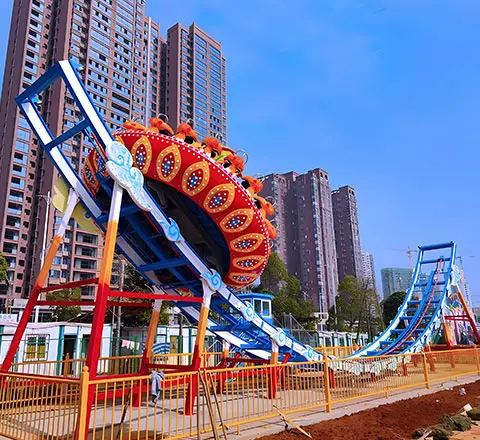


A flying chair ride, also known as a wave swinger, swing carousel, or chair-o-planes, is a popular attraction in amusement parks, family entertainment centers, and outdoor leisure parks. Its rotating canopy and suspended seats create a distinctive swinging motion that offers an enjoyable experience for visitors of different age groups. Proper flying chair ride maintenance is essential to keeping this attraction in good operating condition and ensuring its long-term reliability.
Maintaining a flying chair ride requires regular attention to its mechanical, electrical, and safety components. Suspension chains, seat frames, safety belts, slewing bearings, drive systems, and electrical controls all need to be inspected regularly. Models equipped with pneumatic systems also require checks of their cylinders, solenoid valves, and air connections. Identifying wear, loose connections, and abnormal operating conditions early can help prevent minor issues from developing into equipment failures.
For amusement park operators, unexpected ride breakdowns can result in operational downtime, additional repair expenses, and lost ticket revenue. More importantly, defects in load-bearing components or passenger restraint systems can create serious safety risks if they are not identified and addressed promptly. Establishing a consistent inspection and preventive maintenance routine is therefore essential for responsible ride operation.
As a China-based one-stop amusement equipment manufacturer with more than 20 years of industry experience, Carnee Rides provides comprehensive solutions covering amusement park planning and design, ride selection, equipment manufacturing, installation guidance, and after-sales service. Drawing on our manufacturing expertise and project experience, this guide addresses the practical maintenance needs of flying chair rides, covering daily inspection procedures, critical component maintenance, common mechanical and electrical faults, and preventive maintenance planning.
Whether you operate a small kiddie swing ride, a 24-seat family model, or a 36-seat large commercial swinging chair ride, this guide will help you develop a suitable maintenance routine, recognize potential equipment problems, and minimize unnecessary downtime. Always follow the maintenance manual for your specific ride model and comply with applicable safety regulations.

1. Understand the Main Components of a Flying Chair Ride
Before creating a maintenance schedule, operators should understand which components require attention and why.
A typical commercial flying chair ride consists of several interconnected mechanical, electrical, and passenger-restraint systems.
| Component | Main Maintenance Focus |
| Central support column | Structural deformation, cracks, and connection integrity |
| Rotating canopy and upper frame | Welds, structural joints, and abnormal movement |
| Slewing ring and main shaft | Lubrication, bearing wear, and operating noise |
| Drive motor and gearbox | Temperature, vibration, lubrication, and electrical connections |
| Lifting and tilting mechanism | Mechanical movement, chains, and connection points |
| Suspension chains | Cracks, deformation, corrosion, and dimensional wear |
| Seat frames and attachment lugs | Structural damage, weld cracks, and abnormal abrasion |
| Safety belts and restraint bars | Webbing damage, buckle locking, and connection security |
| Secondary safety wire ropes | Broken strands, corrosion, and loose clips |
| Electrical control system | Wiring, sensors, limit switches, PLC, and emergency stops |
| Pneumatic system (if equipped) | Air pressure, cylinders, solenoid valves, and air leakage |
| Foundation and anchor bolts | Loosening, corrosion, cracks, and settlement |
Not every flying chair model uses exactly the same mechanical or pneumatic configuration. Therefore, operators should identify the components installed on their equipment before carrying out maintenance.
For a better understanding of the mechanical structure and operating principles, see our guide: How Do Flying Chair Rides Work?.
2. Daily Flying Chair Ride Inspection Checklist
Daily inspection is the first line of defense against unexpected equipment problems.
Before opening the ride to passengers, operators and maintenance personnel should complete a systematic inspection rather than simply switching on the power and checking whether the machine starts.
Step 1: Clean the Ride and Surrounding Area
Remove dust, leaves, loose objects, and other debris from the boarding platform and surrounding operating area.
Check that:
- The passenger loading area is clean and unobstructed.
- Safety fencing and entrance gates are in good condition.
- No foreign objects are caught in moving components.
- Seats and passenger contact surfaces are clean and dry.
Step 2: Inspect the Foundation and Anchor Bolts
Visually inspect the foundation and anchor bolt connections.
Look for:
- Loose or damaged anchor bolts.
- Corrosion around exposed metal connections.
- Cracks in the concrete foundation.
- Signs of uneven settlement or structural movement.
Any suspected foundation movement or damaged anchoring components should be evaluated before the ride operates.
Step 3: Check the Central Column and Rotating Structure
Inspect the central support column, upper rotating canopy frame, and other load-bearing structural components.
Pay particular attention to:
- Structural deformation.
- Cracks around welded joints.
- Loose bolted connections.
- Abnormal contact between moving components.
A cracked structural weld or visibly deformed load-bearing member requires immediate attention. Do not continue operating the ride until the issue has been professionally assessed.
Step 4: Inspect Seats, Suspension Chains, and Connecting Pins

Check each passenger seat individually.
Inspect the suspension chains for broken links, cracks, corrosion, and excessive wear. Examine the connecting pins, retaining devices, and seat attachment lugs.
Also check the secondary safety wire ropes, where fitted, for broken strands, fraying, and loose rope clips.
Step 5: Check Passenger Restraint Systems
Inspect every safety belt, buckle, and safety bar.
Confirm that:
- Safety belts have no cuts, tears, or damaged stitching.
- Buckles lock and release correctly.
- Restraint bars move and lock as designed.
- Connections between restraints and seat frames are secure.
- No abnormal free play or damage is present.
Carnee Rides requires safety belts to be replaced every 12 months. Damaged belts must be replaced earlier, even if they have not reached the scheduled replacement date.
Step 6: Inspect the Mechanical Drive System
Check the drive motor, gearbox, main shaft, slewing ring, and other moving components.
Look for oil leakage, abnormal wear, loose connections, overheating signs, and unusual operating noise.
Lubrication should follow the specified maintenance intervals and lubricant requirements for the particular equipment model.
Step 7: Check Electrical and Control Systems
Inspect the electrical cabinet, cables, terminal connections, emergency stop buttons, limit switches, and safety sensors.
Verify that the control system responds correctly to the manufacturer’s prescribed functional checks.
Never bypass a safety interlock or modify PLC parameters to force a ride into operation.
Step 8: Inspect the Pneumatic System, If Equipped
Some flying chair models use pneumatic components to control lifting, chain tensioning, or braking functions.
Check:
- Air compressor condition.
- Air pressure readings.
- Air pipes and connectors for leakage.
- Pneumatic cylinders.
- Solenoid valves.
- Related mechanical lifting and tensioning components.
The operating pressure must remain within the manufacturer’s specified range. Do not adjust pressure or manually release braking components without following the approved maintenance procedure.
Step 9: Complete Empty-Load Test Runs
After all required inspections have been completed, perform controlled empty-load test runs according to the operating manual.
Carnee Rides’ operating guidance requires at least two empty-load test cycles before passenger operation.
During testing, observe:
- Whether the ride starts and stops normally.
- Whether rotation is smooth.
- Whether the suspended seats move consistently.
- Whether abnormal noise or vibration occurs.
- Whether the control and braking systems respond correctly.
Record the results in the daily operation log.
If any abnormal condition is identified, stop the test and investigate the cause before allowing passengers to board.
3. Critical Flying Chair Components: Wear Limits and Replacement Requirements
Some components deserve more attention because they directly affect passenger safety.
3.1 Suspension Chain Wear and Replacement

Suspension chains carry passenger loads throughout the operating cycle. Continuous movement can gradually cause wear at the contact points between chain links.
During inspection, maintenance technicians should:
- Examine every chain link for cracks, deformation, and corrosion.
- Measure suspected worn sections using a vernier caliper.
- Compare the measurements with the original chain dimensions.
- Check connecting points and locking components.
Carnee Rides’ maintenance requirement: When chain wear exceeds 10% of the original chain diameter, the chain must be replaced.
Any cracked or broken chain link requires immediate attention, regardless of the measured wear level.
Replacement chains must match the original design specifications. Do not use an unapproved substitute or attempt to repair a damaged load-bearing chain through temporary welding.
3.2 Suspension Pins and Anti-Loosening Devices
Suspension pins connect important moving and load-bearing components.
Check the pins for:
- Surface corrosion.
- Diameter reduction caused by wear.
- Deformation.
- Damaged threads.
- Missing or ineffective retaining devices.
Cotter pins, locking washers, and other anti-loosening components must remain correctly installed.
Replace worn or damaged pins with manufacturer-approved components of the correct specification.
3.3 Secondary Safety Wire Ropes
Where secondary safety wire ropes are fitted, inspect them for broken strands, fraying, corrosion, and localized damage.
Check the wire rope clips and connecting hardware for secure installation.
If the rope shows damage beyond the manufacturer’s acceptance limits, replace it before returning the ride to service.
3.4 Seat Frames, Attachment Lugs, and Welds
Seat frames are subjected to repeated loading during operation.
Inspect the tubular steel structure for bending, deformation, and cracking.
The seat attachment lugs deserve particular attention because they transfer loads between the seat structure and suspension assembly.
Look for:
- Elongated mounting holes.
- Abnormal friction wear.
- Cracked welds.
- Loose connecting bolts.
- Separation around welded joints.
Any suspected structural crack requires professional assessment. Do not simply cover the damaged area with paint or perform unauthorized welding.
3.5 Safety Belts and Restraint Systems
Passenger restraint components must be checked before every operating day.
Inspect the webbing, stitching, buckle, locking mechanism, and seat connection points.
Safety belts must be replaced every 12 months according to Carnee Rides’ maintenance requirements.
If damage is discovered before the scheduled replacement date, replace the affected belt immediately.
4. Flying Chair Ride Common Faults and Troubleshooting
Even with regular maintenance, mechanical and electrical problems can occasionally occur.
The most important thing is to identify the actual cause instead of repeatedly restarting the equipment or replacing components without diagnosis.
The following troubleshooting guide covers several common operating problems.

4.1 Flying Chair Ride Won’t Start
Possible causes:
- Main power supply problems.
- Loose or damaged electrical connections.
- Emergency stop circuit activated.
- Overload protection triggered.
- Safety interlock not satisfied.
- Faulty limit switch or sensor.
- Motor or control circuit failure.
How to troubleshoot:
First, record the control panel alarm or fault indication.
Check whether the emergency stop circuit has been activated and whether the prescribed operating conditions are satisfied.
A qualified electrical technician should then inspect the power supply, protective devices, wiring, sensors, and control signals.
Do not repeatedly reset the circuit breaker without identifying why it tripped.
4.2 Flying Chair Ride Keeps Tripping
Frequent electrical tripping may indicate a problem in the power supply, motor circuit, or protection system.
Possible causes:
- Electrical overload.
- Damaged insulation.
- Loose electrical terminals.
- Motor overheating.
- Bearing resistance or mechanical obstruction.
- Faulty overload protection components.
How to troubleshoot:
Inspect the electrical cabinet and motor connections.
A qualified electrician should measure the actual supply voltage and current and compare the results with the equipment nameplate and manufacturer specifications.
If the motor is overheating, check ventilation, mechanical resistance, bearing condition, and gearbox operation.
Do not increase the protection setting simply to prevent repeated tripping.
4.3 Abnormal Noise or Vibration During Operation
Unusual noise or excessive vibration should never be ignored.
Possible causes:
- Worn bearings.
- Loose mechanical fasteners.
- Damaged suspension pins.
- Abnormal chain wear.
- Gearbox problems.
- Slewing ring wear.
- Structural deformation or cracked welds.
How to troubleshoot:
Stop the ride and isolate the equipment before inspecting the mechanical components.
Check the central rotating assembly, drive reducer, bearings, suspension connections, and structural joints.
Compare the condition of the moving components with the manufacturer’s drawings and inspection requirements.
If abnormal vibration is related to a structural crack, bearing failure, or damaged suspension component, professional repair is required before operation resumes.
4.4 Suspended Seats Swing Unevenly
Uneven seat movement can affect ride performance and may indicate a mechanical problem.
Possible causes:
- Unequal suspension chain lengths.
- Worn or damaged chain links.
- Loose connecting pins.
- Damaged seat attachment lugs.
- Incorrect assembly.
- Abnormal mechanical balance.
How to troubleshoot:
Compare the suspension assemblies and inspect the connecting points of the affected seats.
Check chain dimensions against the original drawings and manufacturer tolerances.
Do not attempt to correct uneven movement by arbitrarily shortening chains or changing the suspension geometry.
If the cause cannot be identified, contact the manufacturer for technical assistance.
4.5 Pneumatic System Failure or Abnormal Lifting
For models equipped with pneumatic lifting or tensioning systems, insufficient air pressure or component failure can affect the normal operating sequence.
Possible causes:
- Insufficient compressor output.
- Air leakage from pipes or connectors.
- Abnormal pneumatic cylinder operation.
- Faulty solenoid valves.
- Damaged mechanical lifting chains.
- Incorrect pressure feedback.
How to troubleshoot:
Check the pressure gauge and compare the reading with the specified operating range.
Inspect pneumatic pipes, connections, cylinders, and valves for leakage or visible damage.
Qualified maintenance personnel should verify the control signals and pneumatic operation according to the equipment manual.
Do not bypass pneumatic safety controls or manually release brakes to force the equipment to operate.
4.6 PLC or Sensor Alarm
Flying chair rides may use limit switches, proximity sensors, or other electrical feedback devices to monitor operating conditions.
Possible causes:
- Sensor misalignment.
- Dust or contamination on the sensor surface.
- Damaged sensor cables.
- Loose electrical terminals.
- Incorrect feedback signals.
- Faulty PLC input or output components.
How to troubleshoot:
Record the displayed fault code before resetting the system.
Inspect the relevant sensor and its wiring. A qualified technician can verify whether the sensor signal matches the actual mechanical position and whether the PLC receives the expected input.
Clean the sensor surface where appropriate and check its mounting position against the manufacturer’s drawings.
Do not randomly change PLC parameters or bypass safety-related sensor signals.
Important: A fault code is an indication, not a diagnosis. The actual cause must be confirmed before the equipment returns to service.
5. Recommended Preventive Maintenance Schedule

A structured swinging chair ride maintenance schedule helps operators avoid unnecessary breakdowns and manage spare parts more efficiently.
The following is a practical framework. Actual inspection intervals should be adjusted according to operating hours, passenger loads, environmental conditions, and the manufacturer’s maintenance manual.
| Maintenance Frequency | Main Tasks |
| Daily, before opening | Check foundation, restraints, chains, pins, seats, electrical controls, and pneumatic components where fitted; complete at least two empty-load test cycles under Carnee operating guidance |
| During operation | Monitor unusual noise, vibration, movement, and abnormal control indications |
| After daily operation | Clean seats and passenger areas; record defects and maintenance findings |
| Weekly or as specified | Review visible mechanical wear, corrosion, sensor cleanliness, and lubrication requirements |
| Monthly / Quarterly, according to the maintenance plan | Conduct more detailed inspections of chains, wire ropes, seat lugs, structural welds, bearings, and electrical terminals |
| Seasonal maintenance | Check corrosion protection, electrical moisture protection, drainage, motor ventilation, and weather-related damage |
| Annual / Periodic professional inspection | Review structural condition, foundation integrity, safety components, replacement history, and applicable non-destructive testing requirements |
For high-use attractions, more frequent inspections may be necessary.
Non-destructive testing (NDT), such as magnetic particle testing, should be performed when required by the applicable regulations, inspection plan, engineering assessment, or manufacturer instructions. It should not be replaced by visual inspection alone where more detailed examination is required.
6. Rainy Season and Summer Maintenance for Outdoor Flying Chair Rides
Outdoor flying chair rides are exposed to changing weather conditions throughout the year.
Rain, humidity, dust, strong sunlight, and high temperatures can all affect equipment performance.
6.1 Rainy Season: Prevent Moisture and Corrosion
During wet seasons, pay particular attention to:
Steel structure protection
Inspect protective coatings for scratches, peeling, and rust. Repair exposed metal surfaces using the specified corrosion-protection system.
Electrical cabinet protection
Check cabinet seals, cable entries, and electrical connections for moisture intrusion.
Keep the electrical cabinet clean and dry. Use suitable moisture-control measures where necessary.
Mechanical connections
Inspect suspension pins, bearings, chain links, and exposed fasteners for corrosion after prolonged rainfall.
Drainage and sanitation
Clear blocked drainage areas around the foundation and boarding platform. Clean and disinfect passenger seats and contact surfaces regularly.
After heavy rainfall or storms, complete the required inspections before restarting the equipment.
6.2 Summer: Monitor Motor Temperature and Mechanical Loads
During hot weather, continuous operation can increase the temperature of motors, gearboxes, and other mechanical components.
Maintenance personnel should:
- Check motor ventilation and cooling conditions.
- Monitor abnormal temperature increases.
- Inspect gearbox lubrication.
- Check for bearing overheating.
- Maintain the specified operating and rest cycles.
If a motor repeatedly overheats or triggers protection, identify the underlying cause instead of simply reducing the protection setting.
7. Flying Chair Maintenance Records: What Should Park Operators Document?
A maintenance checklist is only useful when inspection results are recorded and followed up.
We recommend maintaining a dedicated equipment log for each flying chair ride.
The record should include:
- Equipment model and identification number.
- Inspection date and responsible technician.
- Daily inspection results.
- Empty-load test results.
- Suspension chain measurement records.
- Safety belt installation and replacement dates.
- Wire rope and pin inspection findings.
- Electrical and pneumatic fault records.
- Lubrication and spare parts replacement history.
- Repairs and corrective actions.
- Final inspection before returning the ride to service.
For example, recording chain measurements over several inspection periods allows technicians to identify progressive wear instead of relying only on visual judgment.
Similarly, tracking the replacement date of each safety belt helps ensure the 12-month replacement requirement is not overlooked.
These records also make it easier to communicate with the original manufacturer when technical support is needed.


8. Common Wave Swinger Maintenance Mistakes to Avoid
Some maintenance problems are not caused by poor equipment quality but by incorrect maintenance practices.
Avoid these common mistakes:
1. Restarting the ride without identifying the fault
Repeatedly resetting a tripped breaker or PLC alarm can hide the actual problem. Always investigate the cause first.
2. Waiting until chains are visibly damaged
Chain wear should be measured against the manufacturer’s limits. A chain may require replacement before obvious damage becomes visible.
3. Using unapproved replacement parts
Pins, chains, wire ropes, restraints, and electrical components must match the original equipment specifications.
4. Ignoring small structural cracks
A small crack around a seat lug or load-bearing weld can become more serious under repeated loading. Stop the affected equipment and arrange professional inspection.
5. Applying incorrect lubricants
Different bearings, gears, chains, and moving components may require different lubricants. Always follow the equipment manual.
6. Bypassing safety devices
Never disconnect safety sensors, alter interlocks, or modify braking circuits to keep a ride operating.
7. Keeping incomplete maintenance records
Without inspection and replacement records, operators may overlook recurring faults and important maintenance deadlines.
9. Why Buying from the Original Flying Chair Manufacturer Matters
Maintenance does not begin when a component fails. It begins with equipment design, manufacturing quality, correct installation, and access to reliable technical support.
For amusement park owners, purchasing directly from an experienced flying chair ride manufacturer offers several practical advantages.
Equipment-Specific Maintenance Guidance
Different flying chair models have different mechanical configurations, drive systems, suspension arrangements, and control systems.
An original manufacturer can provide maintenance instructions based on the actual equipment design instead of generic recommendations.
Compatible Spare Parts
Suspension chains, connecting pins, safety belts, electrical components, and other replacement parts must meet the original specifications.
Sourcing directly from the manufacturer makes it easier to identify compatible components and avoid unsuitable substitutes.
Technical Troubleshooting Support
When a ride develops abnormal noise, vibration, electrical alarms, or pneumatic problems, the manufacturer’s technical team can help identify the relevant components and review the troubleshooting process.
Providing equipment photos, videos, fault codes, and maintenance records can make technical communication more efficient.
Installation and After-Sales Assistance
Proper installation and commissioning are important for long-term equipment reliability.
A manufacturer with relevant project experience can provide installation manuals, technical drawings, operating instructions, remote guidance, and spare parts support. On-site assistance can also be discussed according to project requirements.

10. Need a Flying Chair Ride or Professional Technical Support? Contact Carnee Rides
A reliable flying chair ride is not simply about how smoothly it operates on the first day. Its long-term performance also depends on manufacturing quality, correct installation, appropriate maintenance, and access to professional support.
As a Chinese amusement ride manufacturer serving the industry since 1998, Carnee Rides provides flying chair rides for sale for different park sizes and operating requirements.
Whether you are planning to purchase a new flying chair ride, replace an existing attraction, or need technical advice about maintenance and equipment faults, our team can help with:
- Flying chair ride model selection and equipment configuration.
- Technical specifications and installation drawings.
- Operation and maintenance manuals.
- Spare parts identification and supply.
- Mechanical, electrical, and pneumatic troubleshooting guidance.
- Remote technical support and installation assistance.
- Project-specific after-sales service.
Explore our Flying Chair Rides for Sale to see available models and configurations.
Already operating a flying chair ride and experiencing a technical problem?
You can also contact the Carnee Rides team directly. Share your equipment model, fault description, photos, or operating video, and our team can help you identify the relevant components and discuss suitable troubleshooting solutions.


