
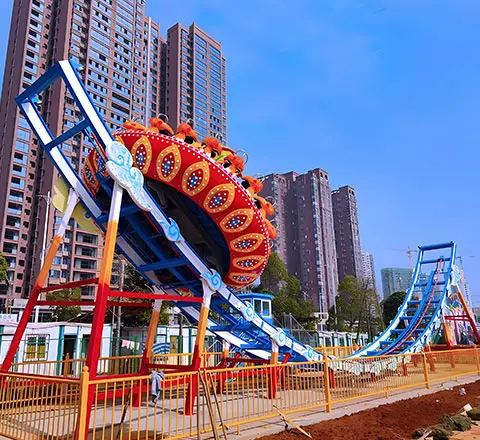


When planning or building an amusement park, carnival, theme park, or indoor Family Entertainment Center (FEC), one critical concept is often overlooked at the early stage: amusement ride level rate.
Understanding how amusement rides are classified by risk level, technical parameters, and regulatory requirements is essential for:
- Amusement Equipment Selection
- Budget planning
- Safety compliance
- Long-term operational efficiency
This guide provides a clear, practical explanation of amusement ride levels, with a focus on A-level, B-level, and C-level amusement rides, based on current Chinese regulations and widely referenced international practices.
1. What is the Amusement Ride Level Rate?
Amusement park ride level rate refers to the official classification of amusement rides according to:
- Operational risk
- Technical parameters (speed, height, capacity)
- Applicable safety regulations
- Approval and supervision authority
In China, amusement rides are regulated as special equipment, and their level classification is primarily defined by:
- Special Equipment Safety Law of the People’s Republic of China
- Special Equipment Safety Supervision Regulation
- Safety Supervision Regulations on Large Amusement Rides
- TSG 71-2023: Large Amusement Ride Safety Technical Code
These regulations determine whether a ride is considered a “large amusement ride” and which level it belongs to.
2. Legal Definition of Large Amusement Rides (Key Thresholds)
According to TSG 71-2023, a ride is legally defined as a large amusement ride if it is operated for commercial purposes and meets either of the following conditions:
- Maximum operating linear speed ≥ 2 m/s
- Operating height ≥ 2 m above ground level
⚠️ This means a theme park ride’s classification depends on measurable parameters, not appearance or size alone.
3. How Amusement Ride Levels Are Classified
Do All Rides Have A/B/C Levels?
No.
Under current regulations:
- Sliding rides and rotating amusement park rides are classified into A-level and B-level
- Water rides, amusement vehicles, and non-powered amusement park rides are not graded, but are managed as B-level equipment
4. A-Level Amusement Rides (Highest Risk Category)


Supervising Authority:
State Administration for Market Regulation (National Level)
Technical Characteristics
A-level amusement rides typically feature:
- High speed
- Significant operating height
- Large passenger capacity
- Complex structures and control systems
Typical Parameter Standards
Examples include:
- Roller Coasters
- Speed ≥ 50 km/h
- or Track height ≥ 10 m
- Observation Rides (Ferris Wheels)
- Height ≥ 50 m
- or Single cabin capacity ≥ 38 passengers
Typical Applications
- Large theme parks
- National-level tourist attractions
- Destination amusement resorts
These amusement park rides require strict approval, national-level supervision, frequent inspections, and higher operational standards.
5. B-Level Amusement Rides (Medium Risk Category)


Supervising Authority:
Provincial Market Supervision Administrations
Technical Characteristics
B-level amusement park rides offer a balance between excitement and accessibility, making them the most common category in commercial projects.
Typical Parameter Standards
- Sliding Amusement Rides
- Speed < 50 km/h
- Track height < 10 m
- Rotating Amusement Rides (Carousel, Self-Control Plane, etc.)
- Rotation diameter < 14 m
- Total passenger capacity < 90 people
Typical Applications
- Regional amusement parks
- Urban entertainment complexes
- Shopping mall FECs
- Mixed-use commercial projects
B-level theme park rides are often preferred due to lower approval complexity, flexible layouts, and strong ROI performance.
6. Rides Managed as B-Level (Not Separately Graded)
The following ride categories are not divided into A or B levels, but are regulated under B-level licensing requirements:
- Water rides
- Water slides
- Wave pools
- Lazy rivers
- Amusement vehicles
- Bumper cars
- Theme park trains
- Non-powered or semi-powered amusement rides
- Zip lines
- Bungee attractions
Supervising Authority: Provincial level
7. C-Level Amusement Rides (Low-Risk Category)


Although not always formally labeled as “C-level” in licensing terms, C-level amusement rides generally refer to equipment with:
- Lower speed
- Lower height
- Smaller passenger capacity
- Reduced operational risk
Typical Examples
- Children’s slides
- Small swings
- Soft play equipment
- Inflatable playgrounds
Typical Applications
- Community parks
- Indoor children’s playgrounds
- Shopping mall play zones
These amusement rides usually require registration or filing only, rather than full special equipment manufacturing licenses.
8. Equipment Typically Exempt from Special Equipment Licensing
Not all amusement attractions fall under special equipment regulations.
Common exemptions include:
- Non-commercial amusement facilities
- Rides with:
- Speed < 2 m/s
- Height < 2 m
- Specific attraction types:
- Inflatable castles
- Rainbow slides
- Glass walkways
- Alpine coasters
- Aerial zip-wire experiences
- Non-rider structures:
- Decorative installations
- Artificial landscapes
- Thematic sculptures
These exemptions are often used strategically to control investment and approval timelines.
9. Key Parameters Used in Amusement Ride Level Evaluation
Understanding these parameters helps investors and operators avoid compliance issues:
- Operating speed (maximum linear speed)
- Operating height (distance from rider support surface to ground)
- Track height
- Passenger capacity
- Rotation diameter
- Swing angle
- Structural complexity
Final classification is based on type testing results and approved design documentation, and amusement park ride manufacturers must not exceed approved parameters during production.
(See more: Top 10 Amusement Park Rides Manufacturers in China (2026) )
10. Why Amusement Ride Level Rate Matters for Investors and Operators
Choosing the wrong ride level can lead to:
- Delays in approvals
- Increased construction and compliance costs
- Operational restrictions
- Safety liabilities
In practice, many successful amusement park projects adopt a balanced mix:
- B-level core rides
- Low-risk, exempt attractions
- Limited A-level signature rides (when justified)
This strategy optimizes safety, cost control, and long-term profitability.
About Carnee Rides
Carnee Rides is a professional amusement ride manufacturer based in China, with over 20 years of industry experience serving amusement parks, theme parks, carnivals, and FEC projects worldwide.
In real projects, we often assist clients during the early planning stage by:
- Clarifying ride level requirements
- Evaluating speed, height, and capacity parameters
- Supporting compliant equipment design and documentation
This early-stage technical alignment helps projects move forward more smoothly while controlling risk and cost.
Final Thought
Understanding amusement ride level rate is not just about regulations—it is about building a park that is safe, compliant, and commercially sustainable.


